
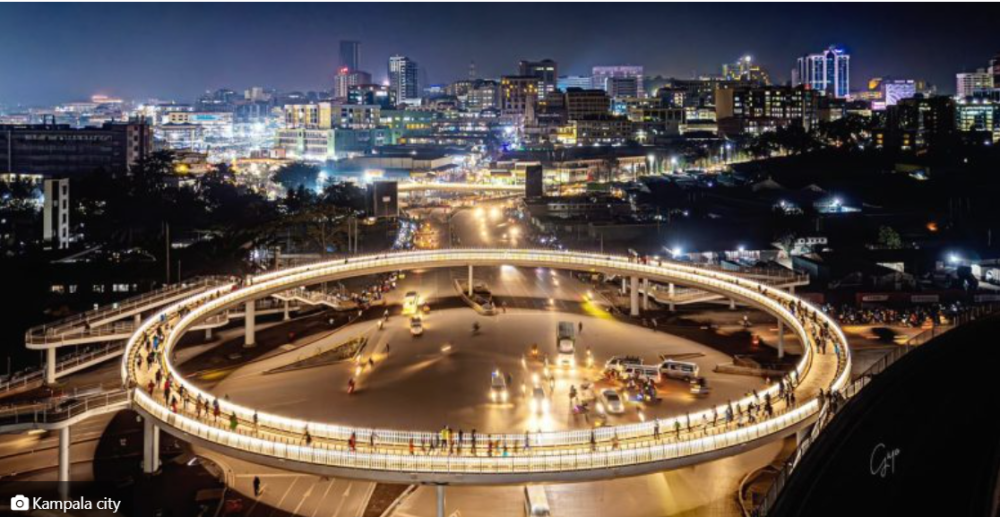
Kampala Mayor Ronald Balimwezo has rejected the Ugandan government’s proposal to gradually relocate ministries, government departments and agencies from Kampala to Nakasongola, arguing that the capital’s infrastructure problems should be addressed through increased investment rather than relocation.
The debate intensified after State Minister for Urban Development Margaret Muhanga told Uganda’s parliamentary committee on Lands and Housing that President Yoweri Museveni supports the idea of gradually moving government institutions from Kampala to Nakasongola.
Muhanga said the transition could take place in phases and potentially continue until 2040, with selected government institutions expected to move first.
Government points to Kampala’s congestion
The government’s proposal is largely being driven by Kampala’s growing congestion, infrastructure pressures and difficulties associated with the city’s rapid expansion.
Muhanga argued that Kampala has become increasingly difficult to live and work in, with traffic congestion imposing a major economic burden on the country.
She said President Museveni strongly supports the idea but acknowledged that moving the capital’s administrative functions would be a long-term undertaking.
“The President strongly supports this idea of moving the capital. But it is not something you can do in one day. It could take until 2040,” Muhanga said.
She also cited the economic cost of traffic congestion, saying Uganda loses about $1.6 billion annually because of delays on the roads.
Traffic congestion becomes a central argument
Muhanga used the daily experience of Kampala residents to illustrate the scale of the problem.
“Who is happy living in this city? I am not happy. We lose $1.6 billion every year because of traffic congestion. People have to wake up at 4 a.m. to get to work at 8 a.m. That does not make sense,” she said.
She argued that Kampala could no longer continue operating under its current conditions and that the country needed to consider moving some of its administrative functions elsewhere.
The proposed relocation would therefore be aimed not only at reducing congestion but also at creating a more deliberately planned administrative centre.
Why Nakasongola?
According to Muhanga, Nakasongola was selected after being considered alongside established urban centres such as Mbarara, Fort Portal and Gulu.
The main advantage, she said, is the opportunity to develop an administrative capital from the ground up rather than attempting to redesign an already congested and heavily developed city.
A purpose-built administrative centre could allow authorities to plan government offices, roads, residential areas, public services and other infrastructure as part of a coordinated urban development strategy.
Kampala mayor calls for investment instead
Balimwezo has taken a different position, arguing that Kampala’s problems are primarily the result of inadequate investment in infrastructure.
Rather than relocating government institutions, he wants the government to provide Kampala with the resources required to expand and modernise its infrastructure.
The mayor pointed to Kampala’s historical role since Uganda gained independence in 1962, saying the city has developed into a major centre for politics, commerce, education, healthcare and transportation.
That position makes the proposed relocation more than a question of geography. It raises broader questions about whether Uganda should redistribute government functions or strengthen the city that has served as the country’s principal political and economic hub for decades.
KCCA faces a major funding gap
Balimwezo’s argument is also rooted in Kampala’s financial constraints.
He said Kampala Capital City Authority (KCCA) requires approximately 2.4 trillion Ugandan shillings each financial year to adequately address the city’s infrastructure needs, but receives only about 40% of that amount.
That leaves a funding gap of roughly 60%, limiting the authority’s ability to implement the infrastructure projects needed to address congestion, roads, drainage, urban development and other public services.
From Balimwezo’s perspective, the funding shortage, not the location of government offices, is at the heart of Kampala’s infrastructure crisis.
Mayor calls for wider public consultation
Balimwezo has also warned against making such a major national decision without extensive consultation.
He argues that relocating government institutions from Kampala would have implications far beyond the civil service, given the city’s role in Uganda’s economy and its long-established concentration of political, commercial and public services.
For him, the debate should therefore focus on how Kampala can be modernised rather than whether the government should abandon part of its administrative infrastructure.
A potential transformation by 2040
If the government proceeds with the proposal, the gradual relocation of ministries, departments and agencies to Nakasongola could significantly reshape Uganda’s administrative geography over the next 14 years.
But Balimwezo’s opposition highlights a fundamental policy question: should Uganda address Kampala’s congestion and infrastructure problems by moving government functions elsewhere, or by investing heavily enough to make the existing capital more efficient?
The answer could determine not only the future of Kampala but also the shape of Uganda’s administrative and urban development strategy for decades to come.