Rwanda’s Ministry of Education has apologized after a student who ranked first nationally in the Lower Secondary School Leaving Examinations was left out of the ceremony where top-performing students were publicly recognized.
State Minister for Education Irere Claudette said the incident was not deliberate and was instead caused by an error in the contact details submitted by the school attended by Uwamariya Leontine.
The controversy spread widely on social media, with some people questioning why the student from Institut Sainte Famille de Nyamasheke (ISF Nyamasheke) had not appeared alongside other high-performing students.
MINEDUC explains how the error happened
Irere said the problem originated from an incorrectly recorded telephone number belonging to Uwamariya’s parent.
She explained that the National Examination and School Inspection Authority (NESA) attempted to contact the student’s family on August 19 after confirming that Leontine had ranked first nationally.
“In writing down the parents’ numbers, these school administrators are making a mistake,” Irere said, explaining that the school had made an error while recording the parent’s contact details.
According to the State Minister, the first number provided was unavailable, prompting NESA to call a second number. The person who answered the second number confirmed that they were the student’s parent.
The NESA official then informed the person that their child had performed exceptionally well and was expected to attend the awards ceremony.
Irere said the same number was contacted again on the day of the ceremony. The person who answered said they could not attend because they were far away.
It was later established that the person was not Uwamariya’s parent. Instead, the school had mistakenly entered that person’s telephone number in the student’s records.
A contact verification failure
The incident exposed a gap in the verification process used when schools submit students’ and parents’ contact information.
Although NESA had attempted to reach the family, the initial verification relied on a telephone contact that had been incorrectly recorded by the school.
Irere said the incident had prompted the ministry and NESA to reconsider whether simply calling a parent is sufficient when students are being invited to major national events.
“We have also learned that it is not enough just to call the parent,” she said.
She added that the process should involve the student, the school and, where necessary, education authorities to ensure that critical information reaches the correct people.
MINEDUC says the incident provided important lessons
Irere identified accurate recording of personal information as one of the main lessons from the controversy.
“When someone is entering the details of a student or anyone else, they have to be careful and do it correctly. That is the first lesson,” she said.
The second lesson, she explained, is the need for multiple levels of communication when students are selected for national recognition.
“Instead of telling only the parent, we should also inform the school, and where necessary, inform the authorities as well,” Irere said.
The approach could reduce the risk of similar incidents involving incorrect telephone numbers, incomplete information or communication failures.
Ministry apologizes over the controversy
Irere said the ministry had not intended to exclude Uwamariya from the national recognition ceremony.
She acknowledged that the outcome was unfortunate and apologized to the student, her family and those who were disappointed by the incident.
“Let us apologize for how this turned into something unpleasant. That was not our intention,” she said.
According to the State Minister, the objective of the ceremony was to recognize students for their achievements and allow the country to celebrate their success.
MINEDUC rejects claims of regional discrimination
The incident also generated debate online, with some people suggesting that Uwamariya may have been overlooked because she came from Nyamasheke District.
MINEDUC rejected that interpretation, saying Rwanda’s education system does not discriminate against students based on where they come from.
“You know very well that the Government of Rwanda does not discriminate. Every child has the same opportunities as another,” Irere said.
She urged the public to focus on the student’s achievement rather than turning the incident into a debate about her geographical origin.
“What we should focus on is what we are celebrating: she passed,” she said, arguing that attention should remain on the student’s success and the fact that she ultimately received the recognition she deserved.
Uwamariya eventually receives her awards
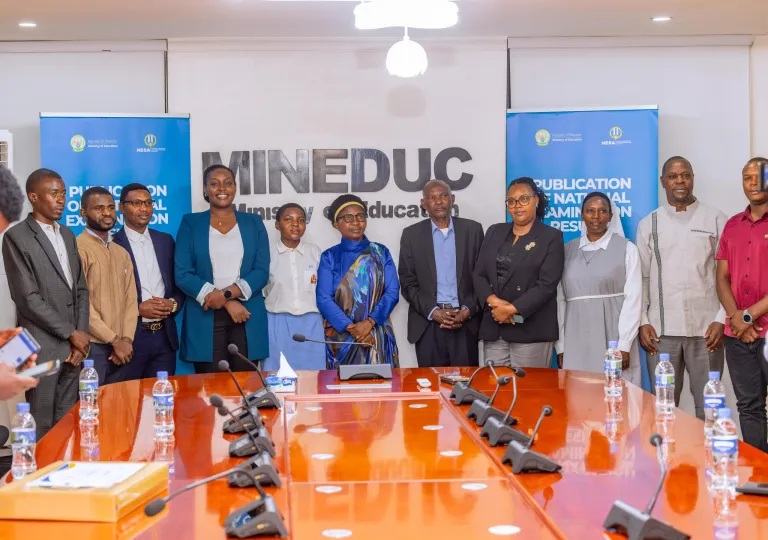
On Friday, August 21, 2026, Uwamariya was received at the headquarters of the Ministry of Education, where she was presented with her awards.
She also met with senior education officials, including State Minister Irere Claudette, and was photographed with ministry officials.
Her appearance at MINEDUC effectively addressed the immediate concern that the student who ranked first nationally had not received the recognition given to other top performers.
Beyond the individual case, however, the controversy has raised broader questions about the accuracy of student records and the reliability of communication systems used by education authorities.
For MINEDUC, the episode has become an opportunity to strengthen verification procedures and ensure that students, parents and schools are all involved when important academic announcements and awards are being communicated.