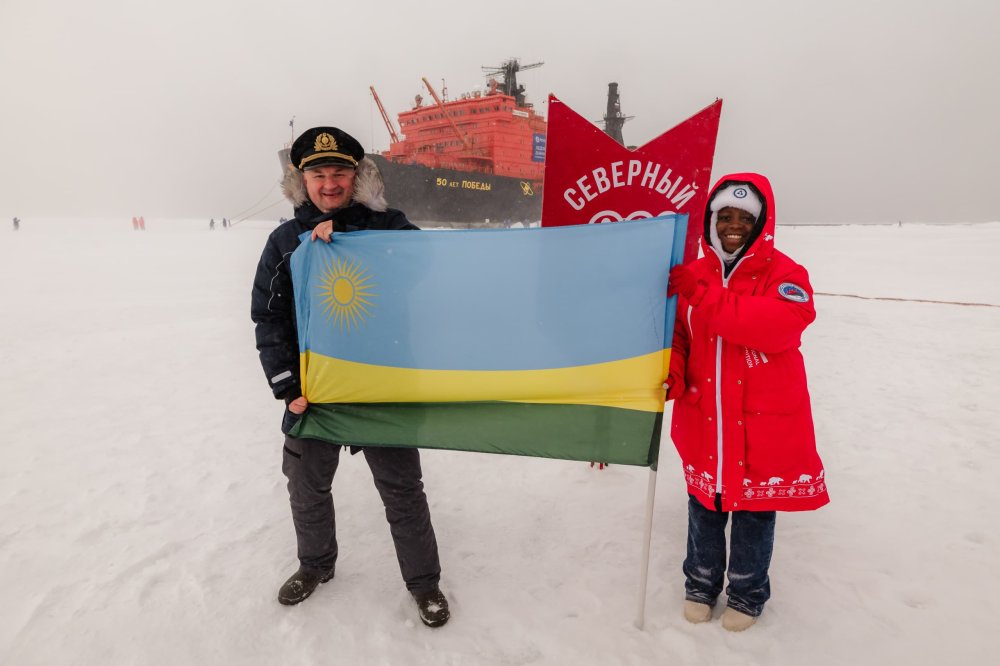
Rwandan student Izere Louise has reached the North Pole for the first time as part of Rosatom’s international Icebreaker of Knowledge expedition, travelling aboard the nuclear-powered icebreaker 50 Let Pobedy and gaining first-hand experience in Arctic science and technology.
The milestone was reached on August 13, 2026, during the seventh international edition of Icebreaker of Knowledge, an educational and research expedition designed to expose talented secondary-school students to scientific work beyond the classroom.
Over 10 days, students from different parts of the world travelled along the Murmansk–North Pole–Franz Josef Land–Murmansk route aboard 50 Let Pobedy.
The expedition also marked the vessel’s 200th voyage to the North Pole, adding historical significance to an initiative focused on developing the next generation of scientists and technology specialists.
Rwandan student takes science experience to the Arctic
For Izere Louise, the expedition offered more than an opportunity to visit one of the most remote regions on Earth. It brought together scientific education, international collaboration and direct exposure to Arctic research.
“Reaching the North Pole is something I will never forget. Seeing the vast ice landscapes with my own eyes made me realise that there is still so much about our planet that needs to be discovered,” Izere said.
She also described representing Rwanda on the expedition as a source of pride and inspiration for her future.
“I was especially proud to make this journey representing Rwanda. This expedition showed me that science can take you to places you once thought were too far away to reach, and it inspired me to dream bigger about my future,” she added.
Nuclear-powered icebreaker takes students to the North Pole
The students travelled aboard 50 Let Pobedy, a nuclear-powered icebreaker operated in Russia’s Arctic fleet and designed to navigate heavy Arctic ice.
Ruslan Sasov, captain of the vessel, said the crew attaches particular importance to the educational expedition because of its role in inspiring young people interested in science.
“We successfully completed the seventh Icebreaker of Knowledge expedition in the Arctic. The ship’s crew always welcomes this project with special enthusiasm because journeys like these make a practical contribution to developing the younger generation,” Sasov said.
He added that many of the young participants had dreamed of reaching the North Pole and seeing Arctic wildlife.
“The young scientists and talented students who take part in this expedition often dream of reaching the North Pole and seeing polar bears. I am very pleased that Rosatom and our crew have helped them achieve those dreams,” he said.
Students participate in Arctic research
The expedition was structured as a scientific learning programme rather than simply an Arctic visit. Participants worked alongside researchers on practical experiments and field activities.
Among the projects was the launch of a radiosonde, a scientific instrument used to collect atmospheric data and support communication and research in remote environments.
Yegor Plakhotnyuk, project manager at the Research Institute of Technical Physics and Automation (NIITFA), said exposing students to real-world scientific challenges was central to the programme.
“At Rosatom, we work every day on things that once seemed impossible in science,” Plakhotnyuk said.
“That is why it is so important for us to show these things to children first-hand, and it is wonderful that we can do this aboard the nuclear-powered icebreaker 50 Let Pobedy,” he added.
According to Plakhotnyuk, the expedition gave participants an opportunity to see how scientific knowledge and advanced technologies can be translated into practical solutions with potential to improve people’s lives.
5,000 students competed for places
Icebreaker of Knowledge is designed to promote environmental science and nuclear-energy-related technology while identifying talented young people, strengthening their skills and exposing them to potential career paths.
About 5,000 students from 22 countries competed for places in the international selection process for this year’s expedition.
The participating countries included Rwanda, Namibia, Egypt, South Africa, Armenia, Bangladesh, Belarus, Bolivia, Brazil, Hungary, Vietnam, India, Indonesia, Kazakhstan, China, Kyrgyzstan, Mongolia, Myanmar, Serbia, Tanzania, Türkiye and Uzbekistan.
The programme targets students aged between 14 and 16 from conventional secondary schools and vocational education programmes, providing them with opportunities to work with scientists and explore possible professional fields.
Rwanda and Rosatom deepen nuclear-energy education cooperation
Izere’s participation comes against the backdrop of growing cooperation between Rwanda and Rosatom in nuclear-energy education, research and human-capacity development.
The partnership dates back to 2019, when Rwanda and Rosatom signed an agreement aimed at developing a skilled workforce for the nuclear-energy sector.
According to the information provided, 18 people who graduated from Russian universities in nuclear-energy-related fields are now working in Rwanda in institutions involved in nuclear energy and related sectors.
In 2025, nine Rwandan students also graduated from the National Research Nuclear University MEPhI in Russia.
20 scholarships allocated to Rwandan students
For the 2026/2027 academic year, Rosatom has allocated 20 places for Rwandan students to study at Russian universities, focusing on nuclear energy and related disciplines.
The cooperation is part of broader efforts to develop the technical and scientific workforce needed as Rwanda explores the role of nuclear technology in long-term development. Izere Louise’s journey to the North Pole therefore represents more than a remarkable personal achievement.
It also highlights the growing role of international scientific programmes in giving young Rwandan students exposure to advanced technology, global research networks and career opportunities in emerging fields.