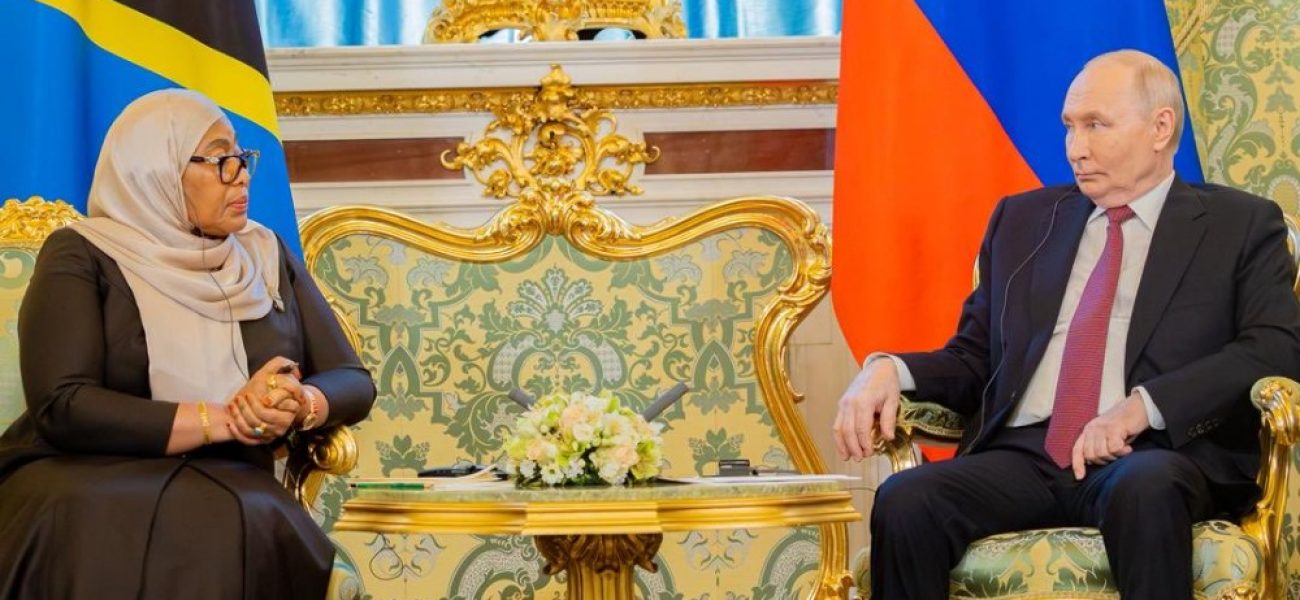
Tanzanian President Samia Suluhu Hassan’s visit to Moscow has become one of the most closely watched diplomatic developments involving Africa this year. The trip, made at the invitation of Russian President Vladimir Putin, carries symbolic and strategic significance far beyond the official agenda announced by both governments.
The visit marks the first time in 57 years that a Tanzanian head of state has traveled to Russia. The last such journey took place in 1969 when Tanzania’s founding leader, Julius Nyerere, visited Moscow during the height of the Cold War.
Officially, the four-day visit is focused on strengthening bilateral cooperation in trade, investment, economic development, education, technology, energy, mining, agriculture, infrastructure, and tourism. After meeting Putin at the Kremlin, President Samia stated that the two leaders had discussed expanding cooperation across multiple sectors and creating new opportunities for their citizens.
She noted that trade between the two countries had grown by 72 percent between 2020 and 2025 and emphasized a shared commitment to deepening economic engagement and investment.
Yet many observers believe the visit is about more than economics.
Russia has spent the past several years rebuilding its diplomatic and economic presence across Africa. Since the outbreak of the war in Ukraine and the subsequent wave of Western sanctions, Moscow has intensified efforts to strengthen relationships throughout the Global South. Africa has become a central part of that strategy.
East Africa, in particular, holds growing strategic value. The region possesses major ports along the Indian Ocean, expanding consumer markets, abundant natural resources, and increasing political influence in continental affairs.
Tanzania occupies a unique position within that landscape. Its ports at Dar es Salaam and Mtwara serve as critical gateways for regional trade, while its political influence within the East African Community continues to grow.
For Russia, engaging Tanzania provides an opportunity to deepen its footprint in one of Africa’s most dynamic regions. Welcoming President Samia at this moment also sends an international message that Russia continues to maintain strong partnerships despite geopolitical tensions with Western powers.
At the same time, Tanzania appears to be pursuing a foreign policy rooted in strategic balance. Like Julius Nyerere during the Cold War, Samia Suluhu has cultivated relationships with a wide range of global actors, including the United States, European nations, China, India, and Gulf countries. Her Moscow visit suggests a continuation of that approach rather than an alignment with any single power bloc.
The discussions have also generated speculation about their potential implications for the Great Lakes region, particularly the Democratic Republic of Congo. Tanzania remains an influential member of the East African Community and has historically played an active role in regional security initiatives, including peacekeeping efforts and multinational missions.
Although there is no indication that Congo was a central topic of the talks, analysts argue that Russia may be interested in strengthening ties with countries that possess significant influence over regional diplomatic and security matters.
The timing is especially noteworthy. The United States remains heavily engaged in diplomatic efforts surrounding eastern Congo, while China continues expanding its economic presence through infrastructure and investment projects. Russia’s renewed engagement signals its intention to remain relevant in a region increasingly viewed as a strategic crossroads of global competition.
Some observers also interpret the visit as a reminder to Western capitals that Tanzania maintains multiple diplomatic options. Across Africa, governments are increasingly seeking partnerships with a variety of global powers rather than relying exclusively on traditional allies.
For Rwanda, Uganda, Burundi, and the Democratic Republic of Congo, the visit reflects a broader trend: East Africa is emerging as one of the most important arenas in the evolving global geopolitical landscape.
Whether Moscow is attempting to build a long-term bridge into East Africa through Tanzania or whether Dar es Salaam is simply broadening its diplomatic choices remains an open question. What is clear, however, is that the region’s strategic importance is growing rapidly, and major powers are paying close attention.
Fifty-seven years after Julius Nyerere’s historic Moscow visit, Samia Suluhu has opened a new chapter in Tanzania–Russia relations. The consequences of that chapter may ultimately extend far beyond the two countries themselves, shaping regional diplomacy and power dynamics across East Africa for years to come.