
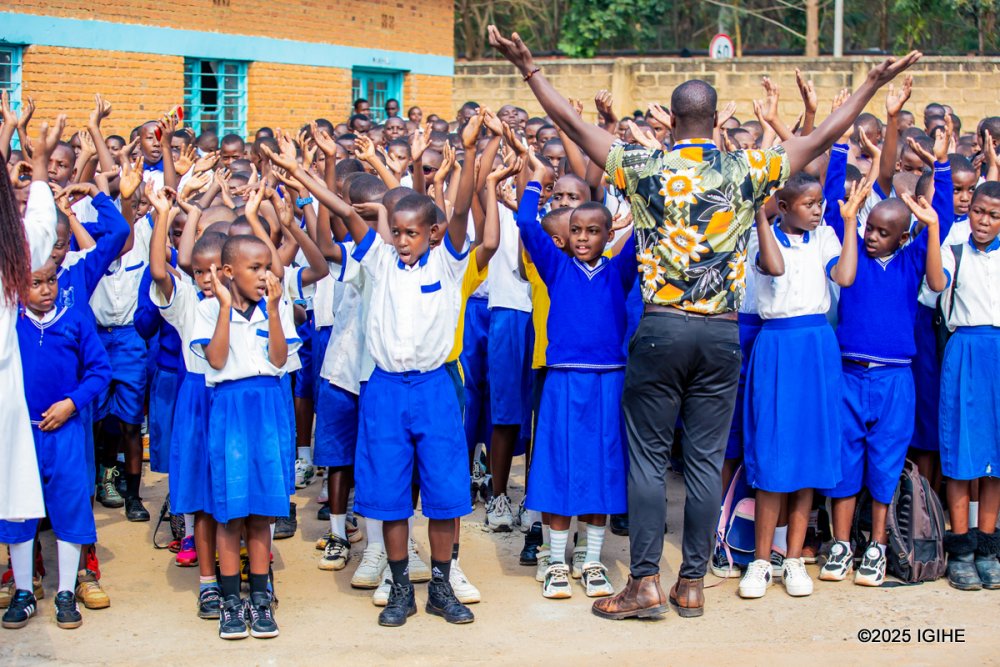
Rwanda’s education system has made remarkable progress over the past two decades, with schools now accessible to most communities across the country. Yet new education statistics reveal an interesting reality: thousands of learners in primary school classrooms are no longer children.
The country’s 2024/2025 education report shows that more than 26,000 learners aged 18 and above are still enrolled in primary education, highlighting both the challenges some citizens faced in accessing education earlier in life and the growing opportunities for adults to return to school.
Education remains central to Rwanda’s Vision 2050, a national development strategy aimed at transforming the country into a high-income economy. The strategy envisions a future where citizens possess the skills and knowledge needed to drive innovation, productivity, and economic growth.
According to the latest figures, more than 4.8 million students were enrolled across Rwanda’s education system during the 2024/2025 academic year. Of those, over 2.9 million were attending primary schools.
Enrollment rates continue to improve. The percentage of children entering primary school within the official age bracket of six to eleven years rose to 95.8 percent, reflecting the success of efforts to make education accessible to all.
However, age distribution data reveals a significant number of overage learners. More than 807,000 primary school students are between 12 and 14 years old, while over 255,000 are between 15 and 17.
Most strikingly, 25,498 learners aged between 18 and 22 remain in primary school. An additional 1,251 learners are older than 22, bringing the total number of adult learners in primary education to 26,749.
The figures suggest that education in Rwanda is increasingly becoming a lifelong opportunity rather than a privilege limited to childhood.
A similar trend appears in lower secondary education. More than 116,000 students aged 18 to 22 are enrolled in this level, while nearly 2,000 are above the age of 22.
Many factors contribute to delayed schooling, including poverty, family responsibilities, migration, school interruptions, and repeated grades.
One of the most inspiring examples is that of 42-year-old Jean Pierre Gumyusenge, who is currently studying in Senior One at GS Ntora.
His educational journey was interrupted in 2000 when he left school while still in primary education because his parents could no longer afford the basic requirements needed for him to continue learning.
Rather than burdening his family, he chose to work and support himself from an early age.
Reflecting on those years, he recalled: “At the age of 12, I worked in marshlands and carried out casual labor.”
After moving to Kigali in search of better opportunities, Gumyusenge built a family and established his life. Yet seeing his children begin their own educational journeys reignited his desire to learn.
In 2019, at the age of 35, he made the bold decision to return to school.
He explained that one of his strongest motivations was helping his children with their studies. As school curricula increasingly relied on English, he realized he needed to strengthen his own education.
Today, his ambition goes beyond earning certificates. He hopes to become a teacher and contribute to the development of future generations.
Returning to school as an adult has not always been easy. Gumyusenge says many people struggle to believe that an older man sitting in a classroom is simply there to learn.
He noted that some individuals, including teachers, initially assumed he was working in an official capacity rather than being a genuine student.
Despite such perceptions, he has remained committed to his studies and continues to move forward with determination.
National statistics indicate that the number of overage learners in primary education is gradually declining. The figure dropped from more than 1.7 million in 2023/2024 to around 1.6 million in 2024/2025.
In lower secondary education, the number of overage students also decreased from 482,394 to 450,213 over the same period.
However, upper secondary education recorded an increase, with overage learners rising from 156,288 to 166,363.
These numbers reflect both the progress Rwanda has made in ensuring children begin school on time and the ongoing effort to provide second chances to those who missed educational opportunities earlier in life.
For students like Gumyusenge, education is not defined by age. It represents a chance to rebuild dreams, acquire new skills, support family members, and participate more fully in the country’s development.
Their stories demonstrate that learning does not end with childhood and that determination can reopen doors long after they seem to have closed.