
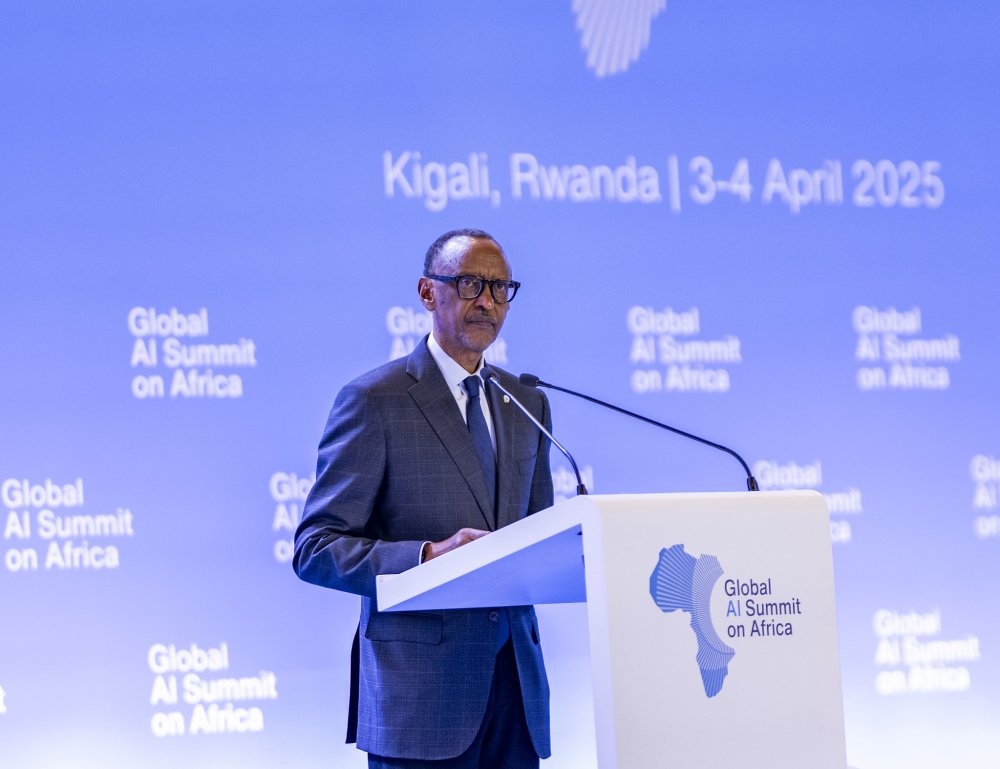
Rwandan President Paul Kagame has been appointed Chair of the newly established AI for Good Global Commission, a United Nations-backed initiative created to promote the responsible and inclusive development of artificial intelligence around the world.
The appointment places Kagame at the center of one of the most important global conversations of the digital age, as governments, technology companies, and international organizations seek ways to harness AI for economic growth, social progress, and sustainable development.
Kagame will co-chair the commission alongside Salesforce Chief Executive Officer Marc Benioff, while International Telecommunication Union (ITU) Secretary-General Doreen Bogdan-Martin will serve as Vice Chair.
The commission was established with support from both the ITU and UNESCO. Its mission is to ensure that artificial intelligence becomes a force for global good, particularly by helping narrow the technology gap between advanced economies and developing nations.
Rather than focusing primarily on strict regulation, the commission aims to facilitate international dialogue, develop technical guidance, strengthen national capacities, and encourage cooperation among governments, private-sector innovators, and development institutions.
The launch of the commission comes at a time when artificial intelligence is rapidly transforming industries ranging from healthcare and education to finance, agriculture, transportation, and public administration. While AI offers unprecedented opportunities, many experts warn that unequal access to technology could deepen existing global inequalities.
One of the commission’s central objectives is therefore to ensure that developing countries are not left behind as AI becomes increasingly integrated into modern economies.
The new body begins its work with significant influence. More than 40 leaders from technology, government, business, and international organizations have joined the commission.
Its membership includes some of the most recognizable names in global technology, including Nvidia CEO Jensen Huang, Amazon CEO Andy Jassy, Microsoft Vice Chair Brad Smith, and executives from leading AI firms such as Anthropic and Cohere.
Other members include leaders from Accenture and Reliance Industries, heads of state from Estonia and Iceland, ministers from Singapore and Nigeria, senior United Nations officials, and representatives of the African Union.
The commission builds on the legacy of the UN Broadband Commission, which worked from 2010 to 2025 to expand internet access worldwide. Kagame played a prominent leadership role in that effort, helping advance digital connectivity initiatives across developing regions.
His appointment reflects Rwanda’s growing reputation as one of Africa’s leading technology and innovation hubs. Over the past two decades, the country has invested heavily in digital infrastructure, e-government services, innovation ecosystems, and technology-driven development.
Today, artificial intelligence is already being applied across multiple sectors in Rwanda, including healthcare, education, justice, agriculture, commerce, and public security. Policymakers view AI as a key driver of future economic transformation.
That ambition was reinforced on June 8, 2026, when Rwanda’s Cabinet approved the creation of a National Artificial Intelligence Center. The institution is expected to accelerate innovation, attract investment, support implementation of AI projects, and improve governance through advanced technologies.
Observers believe Kagame’s leadership within the commission will focus strongly on ensuring that developing countries have access to the knowledge, infrastructure, and resources needed to participate meaningfully in the AI revolution.
Another major priority is expected to be transforming AI concepts into practical investments and scalable solutions capable of improving everyday lives and creating economic opportunities.
For Marc Benioff, who will share leadership responsibilities with Kagame, one of the defining challenges surrounding AI is maintaining public trust.
The Salesforce co-founder has repeatedly argued that technological advancement alone is not enough. According to his vision, the benefits of artificial intelligence will only be fully realized if users can trust that these systems are safe, transparent, and aligned with human interests.
He believes that potential risks associated with AI must be addressed proactively to ensure the technology remains a tool for empowerment rather than a source of uncertainty.
Kagame’s appointment is widely viewed as another milestone in Rwanda’s expanding international profile. It also strengthens Africa’s representation in global discussions about the future of artificial intelligence at a moment when decisions made today are expected to shape the world’s technological landscape for decades to come.