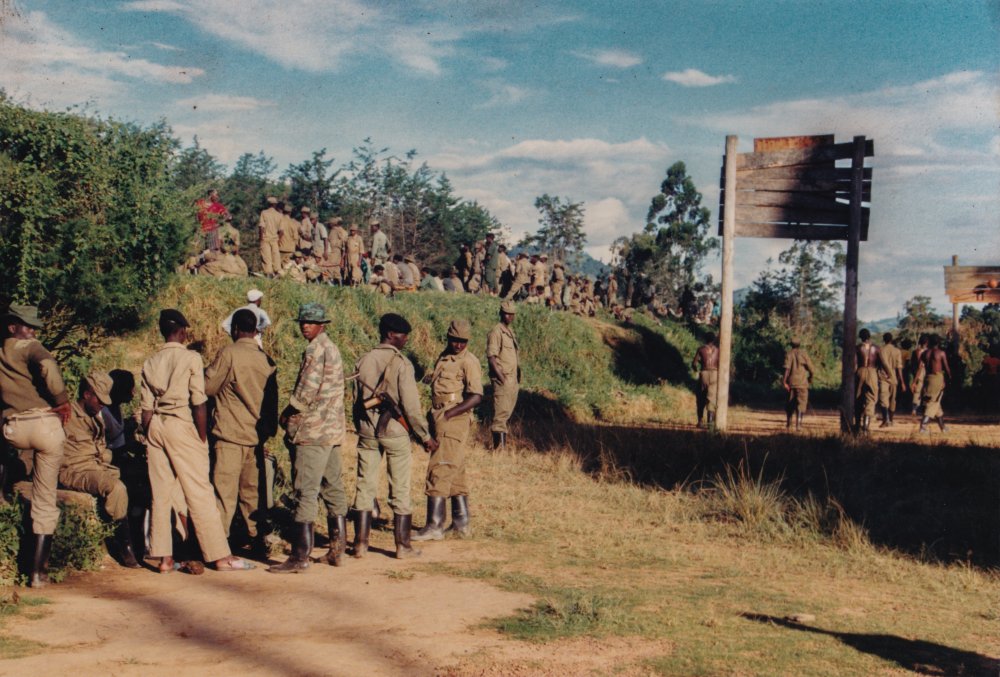
When the Genocide against the Tutsi erupted across Rwanda in April 1994, the soldiers of the Rwanda Patriotic Army (RPA) found themselves fighting two battles at once. They were advancing militarily against government forces while also racing to save civilians targeted for extermination.
For many young fighters on the front line, the horrors they witnessed created an overwhelming sense of anger and grief. Among them was Patrick Karuretwa, now the spokesperson of the Rwanda Defence Force (RDF), who was still a teenager at the time.
Speaking on July 5, 2026, Brig Gen Karuretwa reflected on the difficult days when RPA soldiers entered areas devastated by mass killings and came face-to-face with the reality of genocide.
According to him, the journey toward Kigali exposed soldiers to scenes that were far worse than anything they had heard on international radio broadcasts.
“We reached Nyacyonga on our way to Kigali and that is when the signs of genocide became real before my eyes. We saw bodies everywhere and the horrific ways in which people had been killed. What we had heard on the radio was now unfolding in front of us. Some of our fellow soldiers even discovered the bodies of their relatives, parents, siblings and loved ones,” he recalled.
The emotional impact was enormous. Many soldiers struggled to understand how such crimes could have been committed. For young fighters carrying weapons and trained for combat, revenge seemed like a natural reaction.
Karuretwa openly admitted that he shared those feelings.
As a teenager who had not yet reached the age of 20, he believed that those responsible for the massacres deserved immediate punishment. Many of his comrades felt the same way.
Yet despite the rage that existed within the ranks, the leadership of the RPA took a different path.
The message delivered by then RPA commander Paul Kagame was simple but decisive: soldiers were not to seek revenge.
Karuretwa explained that among the troops, the phrase “The Commander has spoken” carried immense weight. Once an order was given, it became a guiding principle for every soldier regardless of personal emotions.
Looking back, he believes that decision prevented Rwanda from descending into another cycle of violence.
He acknowledged that the anger remained with him even after entering Kigali, but discipline and trust in leadership convinced soldiers that justice would be pursued through other means rather than retaliation.
The end of the liberation war on July 4, 1994 brought another challenge. Rwanda needed not only to rebuild its institutions but also to create a new national army capable of uniting former enemies.
One of the most controversial decisions at the time was the integration of former soldiers from the defeated Forces Armées Rwandaises (Ex-FAR) into the new military structure.
Karuretwa said that if someone had asked him as a young private or corporal whether such a move made sense, he probably would have opposed it. The former government soldiers had been their battlefield adversaries.
Today, however, he views that decision as one of the foundations of Rwanda’s reconciliation process.
He explained that even during the war, captured Ex-FAR soldiers were sometimes integrated into RPA ranks while retaining their military status and dignity. This sent a powerful message that the enemy was not an individual soldier but a destructive political ideology.
According to Karuretwa, Kagame’s leadership consistently emphasized that poor governance and extremist policies, not entire groups of people, were the true adversaries.
That philosophy helped transform former opponents into colleagues and eventually into leaders within the modern Rwanda Defence Force.
More than three decades later, Rwanda’s military is widely recognized for its professionalism both at home and in international peacekeeping operations. Karuretwa believes that this reputation can be traced back to difficult choices made during the darkest days of 1994.
For him, Rwanda’s story is not only one of military victory. It is also a story of restraint, discipline and a deliberate refusal to allow grief and anger to dictate the nation’s future. The decision to reject revenge, he argues, became one of the most important building blocks of the unity and reconciliation that Rwanda continues to pursue today.