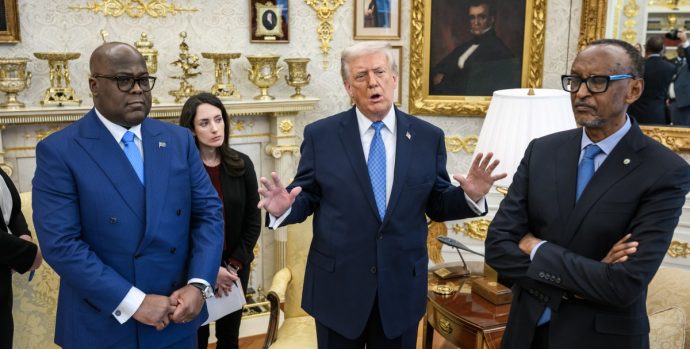
One year after Rwanda and the Democratic Republic of Congo signed the Washington Peace Agreement, hopes for a breakthrough in one of Africa’s longest-running conflicts are increasingly being tested by delays, security challenges, and growing international frustration.
The latest warning came from the United States, which played a central role in brokering the agreement. Speaking before the United Nations Security Council on Friday, President Donald Trump’s Senior Adviser for Africa, Massad Boulos, expressed concern over what he described as insufficient progress by both Kigali and Kinshasa.
According to Boulos, neither side has fully met its commitments under the agreement. He pointed to the continued presence of the FDLR in areas controlled by the Congolese government and the persistence of Rwanda’s security measures, alongside allegations of support for the M23 movement.
“DR Congo has failed to dismantle the FDLR in territories under its control. Rwanda has not withdrawn its forces and has not ended its support for M23. These delays can no longer be tolerated,” Boulos said.
His remarks carried a clear warning that Washington is prepared to increase pressure if implementation continues to stall.
“Inaction or obstruction of the agreement’s implementation will result in additional accountability measures,” he stated.
The warning comes after a series of sanctions already imposed by the United States. In March 2026, Washington sanctioned several Rwandan military officials over alleged support for M23. Additional sanctions announced this week targeted individuals and entities accused of involvement in illicit mineral trade networks linked to eastern Congo.
Boulos urged both governments to abandon any path that could lead to renewed conflict and instead commit fully to the peace roadmap.
“Our message is clear: abandon any path that risks war and move urgently and completely toward implementing the peace commitments you have made,” he said.
His concerns were echoed in a new report released by the Barometer of Peace Agreements in Africa (BAPA), which paints a sobering picture of the agreement’s first year.
The report shows that only 35 percent of the Washington Agreement has been implemented so far.
Out of 30 planned commitments, only three have been fully completed. Eight have not even started, while the remainder are progressing at varying speeds.
Country-by-country assessments reveal that DR Congo has implemented 31.7 percent of its obligations, while Rwanda stands at 30.6 percent.
International mediators, including the United States, Qatar, and the African Union, have performed considerably better, achieving 53.5 percent of their commitments.
BAPA Executive Secretary Dr. Roger-Claude Liwanga noted that progress has largely been limited to institutional and administrative arrangements rather than concrete security improvements on the ground.
“Without meaningful security progress, this agreement risks becoming diplomatic tourism with no visible impact on people’s lives. That is where we stand today,” Liwanga warned.
One of the report’s most significant concerns is the absence of a clearly defined verification mechanism for the dismantling of the FDLR.
“That is a serious problem. In a few months, DR Congo may claim that the FDLR has been dismantled, while Rwanda may argue that it has not, because the two sides never agreed on the benchmarks that would be used,” Liwanga explained.
The report also highlights continued fighting between AFC/M23 and the Congolese army, FARDC, particularly in South Kivu. The growing use of drones in military operations has further intensified the conflict and increased risks for civilians.
Although institutions such as the Joint Security Coordination Mechanism have been established to oversee implementation and security coordination, analysts say these structures have not yet translated into tangible improvements on the ground.
BAPA also reviewed the parallel Doha talks between the Congolese government and AFC/M23, concluding that progress has been limited. Analysts argue that one major weakness is the exclusion of numerous armed groups operating in eastern Congo.
“There are armed groups that do not consider themselves part of either process. It would be wise to find a way to include them now, otherwise we may eventually find ourselves back where we started,” Liwanga cautioned.
Beyond security concerns, major economic projects linked to the peace initiative are also facing delays. Among them is the Rusizi III hydropower project, which was expected to symbolize a new era of regional cooperation but remains affected by insecurity and mutual distrust.
Observers note that the Trump administration invested heavily in the Washington Agreement partly because of the economic opportunities tied to eastern Congo’s vast mineral resources, including cobalt, coltan, and copper.
Yet one year later, the findings suggest that lasting peace will depend less on diplomatic ceremonies and more on political will, trust-building, and the practical implementation of commitments made by all parties involved.
As Washington signals the possibility of further sanctions, attention is now turning to whether the agreement’s second year will produce real change, or whether it will become what some analysts increasingly describe as a diplomatic process rich in promises but poor in results.
Tubibutse ko mushobora gukomeza kudukurikirana ku mbuga nkoranyambaga.
Kanda hano udukurikirane kuri Facebook, Hano udukurikirane kuri WhatsApp