A year after Rwanda and the Democratic Republic of Congo signed the Washington Peace Agreement amid hopes of ending decades of instability in eastern Congo, the deal remains largely unimplemented, with both sides accusing each other of failing to honor key commitments.
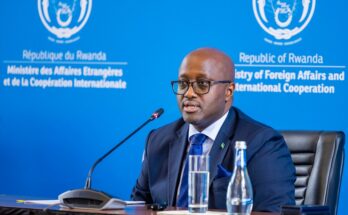
Rwanda’s Minister of Foreign Affairs and International Cooperation, Olivier Nduhungirehe, has argued that the agreement’s slow progress is primarily the result of what he describes as a lack of political will in Kinshasa and the continued presence and support of the FDLR, a group Rwanda considers a major security threat.
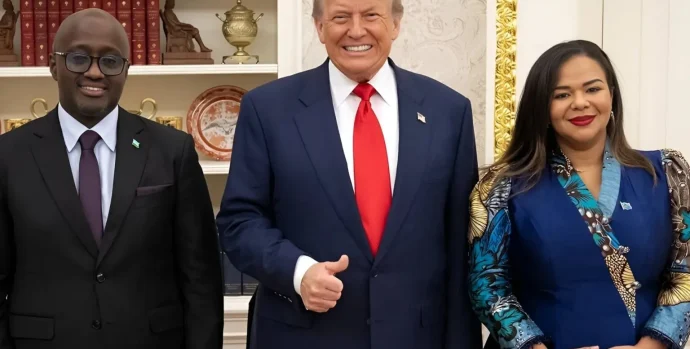
The agreement was signed in Washington on June 27, 2025, by Nduhungirehe and Congolese Foreign Minister Thérèse Wagner Kayikwamba. It later received formal endorsement from Presidents Paul Kagame and Félix Tshisekedi in the presence of U.S. President Donald Trump on December 4, 2025.
Although the accord was presented as a roadmap toward peace, security, and economic cooperation in the Great Lakes region, several of its central provisions remain unresolved.
Last week, Massad Boulos, a senior adviser on African affairs to the U.S. administration, told the United Nations Security Council that neither side had fully delivered on its commitments. He noted that Rwanda had not yet completed the withdrawal of its forces while the Congolese government had failed to dismantle the FDLR.
Speaking to France 24, Nduhungirehe rejected suggestions that the agreement itself was flawed, insisting that the real obstacle lies in its implementation.
According to the Rwandan minister, one of the agreement’s most important provisions required the neutralization of the FDLR alongside the removal of Rwanda’s defensive security measures. He stressed that a 90-day implementation framework had already been established but claimed that Kinshasa had not demonstrated the political determination necessary to carry it out.
Nduhungirehe further alleged that instead of dismantling the FDLR, Congolese authorities had strengthened the group both militarily and politically over the past year.
He also accused the Congolese army of escalating military operations despite the agreement’s commitment to de-escalation and confidence-building measures. According to Rwanda’s position, drone strikes targeting M23 positions and Banyamulenge communities in South Kivu have continued since the agreement was signed.
When asked about Congolese claims that operations against the FDLR had already begun, Nduhungirehe questioned the results of those efforts, arguing that there was little evidence of meaningful action on the ground.
The minister pointed to remarks made by U.S. Secretary of State Marco Rubio before members of Congress on June 5, 2026, as proof that Rwanda has been making greater efforts to comply with the agreement. He said Rubio acknowledged Rwanda’s progress while expressing concerns over the lack of visible implementation steps by the Congolese government.
Rubio also voiced optimism that Rwandan forces could leave Congolese territory by mid-July 2026. However, Nduhungirehe clarified that this was not a deadline imposed by Washington. Instead, he said, it originated from a proposal submitted by Rwanda itself as part of efforts to accelerate implementation.
Beyond the peace process, Nduhungirehe criticized U.S. sanctions imposed on Rwanda over the conflict in eastern Congo. He argued that sanctions directed at only one party undermine the neutrality expected from a mediator and are unlikely to produce lasting solutions.
The minister maintained that sustainable peace can only emerge if both parties fulfill the obligations they accepted under the Washington Agreement. He warned that expecting one side to comply while the other delays implementation would weaken confidence in the entire process.
His remarks underscore the growing tensions surrounding the future of the Washington Peace Agreement. While Rwanda continues to insist that dismantling the FDLR remains the central unresolved issue, Congolese authorities maintain that Rwanda must withdraw its forces from Congolese territory.
As diplomatic efforts continue, the agreement remains a crucial but fragile framework whose success will depend on whether both governments can overcome deep mistrust and transform their commitments into concrete action on the ground.