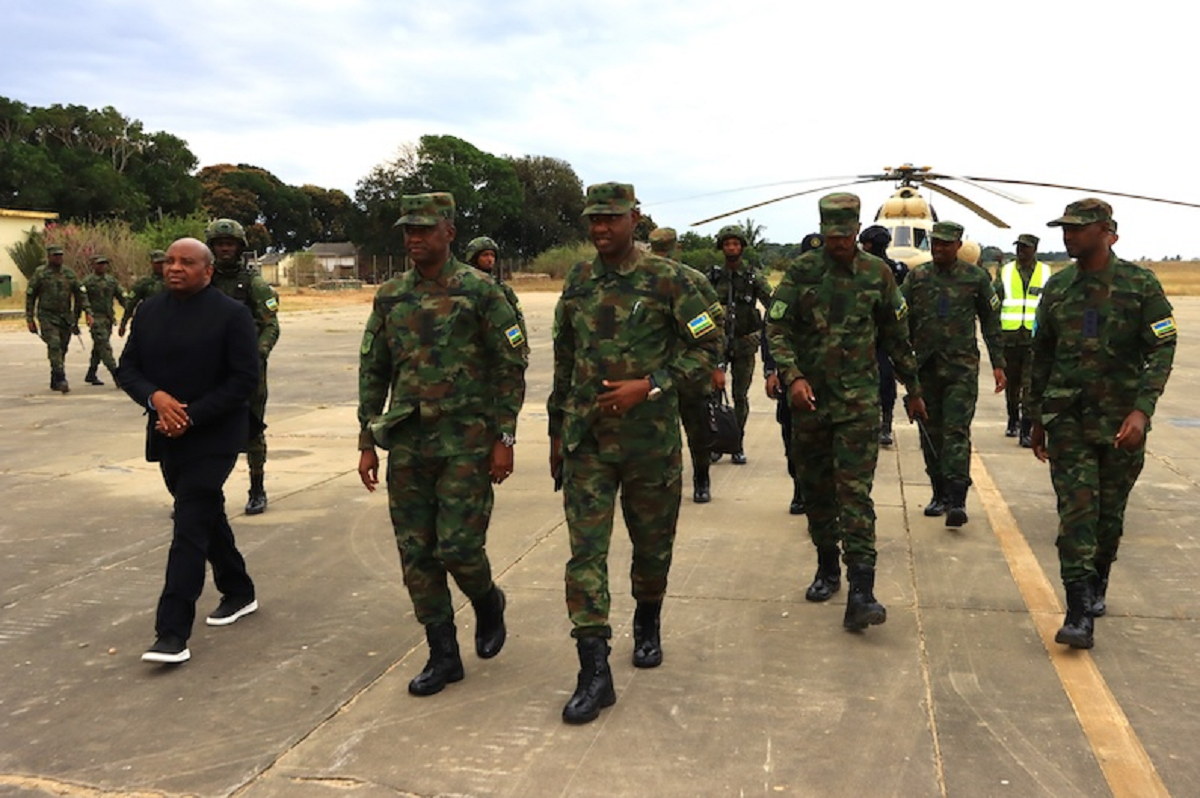
Mozambique has agreed to fully finance the operations of Rwandan troops deployed in Cabo Delgado after the European Union decided to suspend further financial support for the mission, a development that comes amid growing political tensions and reports of unpaid debts owed to Rwanda.
The decision was announced on Tuesday, May 19, 2026, by Rwanda’s Minister of Foreign Affairs, Olivier Nduhungirehe, following high-level discussions between Kigali and Maputo over the future of Rwanda’s counterterrorism mission in northern Mozambique.
The EU had previously contributed around €20 million through the European Peace Facility to support Rwanda’s operations against insurgent groups in Cabo Delgado. However, European officials recently signaled a shift in policy, saying the bloc now prefers to focus on training Mozambique’s national army rather than continuing direct support for Rwanda’s deployment.
EU Ambassador to Mozambique Antonino Maggiore recently confirmed that the bloc was reconsidering the mission.
“We are currently in discussions because the mission, as I said, has now lasted four years and the objective is to discuss how it could be renewed. It is a decision that will be taken by the 27 member states,” he said.
Asked whether the EU would continue funding Rwanda’s mission, Maggiore replied, “for now, no.”
The comments fueled speculation that Rwanda could withdraw its forces from Cabo Delgado if long-term financing was not secured.
In a strongly worded statement, Foreign Affairs Minister Olivier Nduhungirehe defended Rwanda’s role in Mozambique and accused some European countries of politicizing the mission despite its security achievements.
“In 2021, Rwanda’s security forces deployed to Cabo Delgado at the invitation of the Government of Mozambique. Over the past five years, the mission has been successful: peace and stability have returned, families have gone back home, children returned to school, businesses reopened, Mozambique’s army has been trained and continues to receive training, while American and European companies resumed their $50 billion gas investments in a stable environment,” he said.
He also emphasized that EU financial support represented only a small fraction of Rwanda’s overall operational costs in Cabo Delgado.
“At the same time, Rwanda’s security forces received financial assistance from the European Peace Facility, which represented only a minor share of Rwanda’s total expenditures in Mozambique and of the EU’s economic interests in Cabo Delgado,” he added.
Nduhungirehe further accused certain European states of turning Rwanda’s security contribution into a political bargaining tool.
“Unfortunately, we observed that Rwanda’s requests to the EU were met with hesitation and politicized by some EU member states, including two former colonial powers. The crucial support we provide to the people of Mozambique was turned into leverage against Rwanda while being undervalued by countries economically benefiting from our contribution in Cabo Delgado,” he stated.
Following those tensions, Rwanda decided to negotiate directly with Mozambique, which ultimately agreed to continue financing the mission.
“This is why Rwanda returned to basics this year by deciding to engage only with the Government of Mozambique, which has provided and will continue to provide primary support for Rwanda’s security forces in Cabo Delgado. Cooperation between our two governments has worked well and will continue as Rwanda’s contribution remains highly appreciated by the brotherly nation of Mozambique,” he said.
The announcement comes amid reports that Mozambique had accumulated significant unpaid bills related to Rwanda’s military operations.
According to Africa Intelligence, Maputo’s debt to Rwanda had reached approximately $22 million, representing nearly a full year of delayed payments under agreements reportedly signed between the two governments.
The reports indicate that Mozambique was expected to contribute roughly $2 million per month toward Rwanda’s deployment, while the actual operational costs of the mission are estimated to range between $10 million and $20 million monthly.
Mozambique’s financial struggles are believed to be one of the major reasons behind the delayed payments. The country’s public debt reportedly stands at nearly 71% of GDP, while most tax revenues are consumed by government salaries and public expenditures.
Political divisions within the ruling Frelimo party have also reportedly complicated the issue. Some officials oppose the long-term presence of foreign troops in Mozambique, while others argue that Rwanda’s forces remain essential because Mozambique’s military is not yet capable of independently securing Cabo Delgado.
At the same time, major energy companies operating in the region, including TotalEnergies and ExxonMobil, are said to be pressuring President Daniel Chapo’s administration to maintain Rwanda’s military presence at least until 2029 or 2030 to guarantee security around multibillion-dollar gas projects.
Before the latest agreement with Mozambique, Minister Nduhungirehe had already warned that Rwanda could reconsider the deployment if its troops continued to face political pressure and sanctions.
“We reminded everyone that Rwanda’s forces are serving Mozambique, the Mozambican people and the wider international community, including international companies investing there. They cannot continue carrying out this mission while constantly facing criticism, sanctions and political pressure,” he said.
Rwanda first deployed troops to Cabo Delgado in July 2021 at the request of Mozambique’s government after insurgent attacks destabilized the region beginning in 2017. Since then, multiple contingents of Rwandan forces have rotated through the mission, which Kigali says has helped restore stability and reopen economic activity in the region.