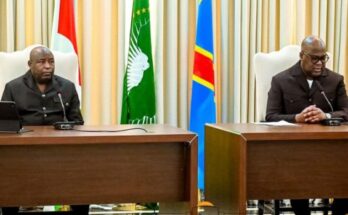
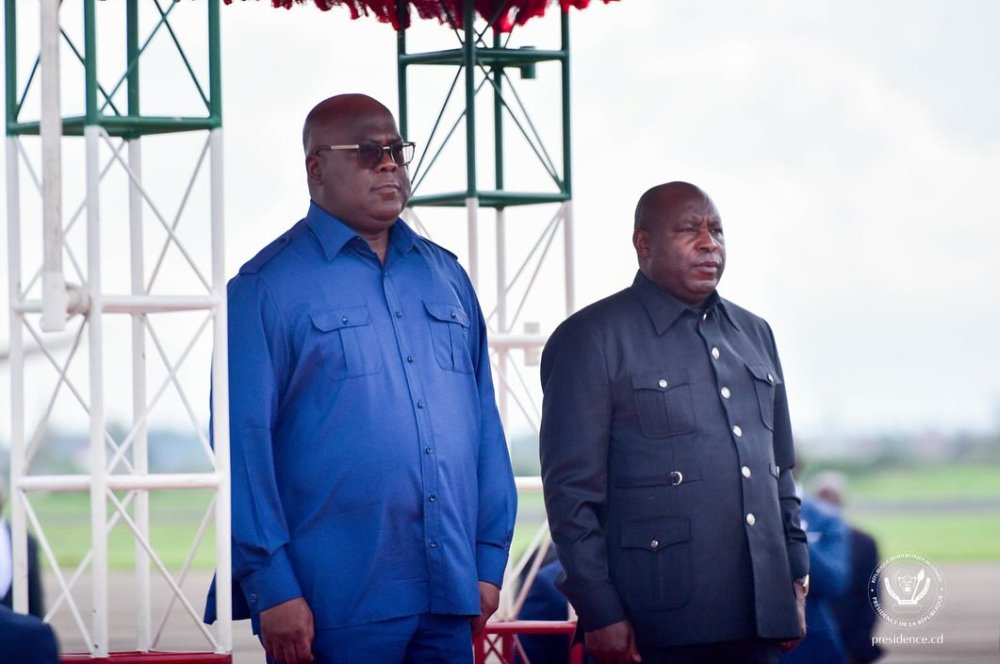
A new phase of fighting has emerged in the Minembwe highlands as Burundi’s President Évariste Ndayishimiye prepares for a two-day visit to Kinshasa, where regional security and the conflict in eastern Democratic Republic of Congo are expected to dominate discussions with President Félix Tshisekedi.
According to the Congolese presidency, Ndayishimiye is scheduled to arrive at N’djili International Airport on June 22 before holding a private meeting with Tshisekedi at the Cité de l’Union Africaine, followed by a joint press briefing.
Officials in Kinshasa say the talks will focus on shared concerns, including the security crisis in eastern Congo and efforts to contain recurring Ebola outbreaks.
The visit comes at a sensitive moment for both countries. Burundi and the DRC have maintained a military partnership since 2022, later renewed in 2023, allowing Burundian troops to operate alongside Congolese forces in ongoing military campaigns across South and North Kivu.
While diplomats prepare for talks in Kinshasa, the battlefield situation around Minembwe remains highly contested.
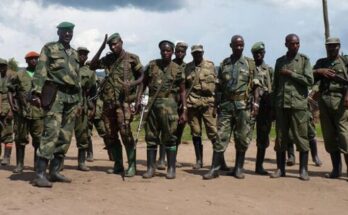
In recent days, Congolese government forces, supported by Burundian troops and allied armed groups, have intensified operations aimed at regaining strategic positions in the Minembwe area.
Speaking to members of the Congolese diaspora in Houston on June 17, President Tshisekedi expressed confidence in the performance of government forces, suggesting that military advances in Minembwe could eventually pave the way for efforts to recover larger urban centers such as Goma and Bukavu.
Shortly afterward, the Congolese military announced that it had taken control of Minembwe. The claim was immediately rejected by both the political and military leadership of MRDP-Twirwaneho.
MRDP-Twirwaneho President Dr. Freddy Kaniki dismissed the announcement and insisted that government forces had failed to achieve their objective.
“I think they want them to have done it. They didn’t do it and they won’t do it. Write that on a rock, it will not change,” he said.
The movement also accused FARDC, Burundian troops, FDLR fighters and Wazalendo elements of launching major attacks during the previous week, alleging that civilians were among the primary targets.
On June 21, Colonel Fidèle Rugabo, one of Twirwaneho’s senior commanders, claimed that his forces were continuing to push back government troops and their allies from positions around Minembwe.
In one statement, he declared: “Akebo ni geramo. Gakenke baraducokoje, reka tubavugutire umuti ubakwiye FARDC, FDNB, Waza, FDLR n’abandi. Muzakumbura Minembwe. Turaje ni mu kanya.”
Later the same day, Rugabo announced what he described as the capture of key locations including Gakenke, the area known as Kwa Rutaganda, and Sinai Hill.
“Gakenke, especially the area known as kwa Rutaganda and Mount Sinai, has been liberated. FNDB, FDLR, FARDC, and their allies have scattered in seven directions,” he stated.
Additional reports suggested that Twirwaneho fighters may also have taken control of Mikenke, although the movement had not officially confirmed that claim at the time.
The reported gains add to other locations including Buhimba, Ilundu, Kwa Harera and Ruhinamavi, areas that government forces previously controlled before launching operations aimed at capturing Minembwe center.
As Presidents Ndayishimiye and Tshisekedi meet in Kinshasa, developments on the ground in Minembwe are likely to influence regional calculations. With competing narratives emerging from both sides, the battle for the strategic highlands remains one of the most closely watched fronts in eastern Congo’s evolving conflict.