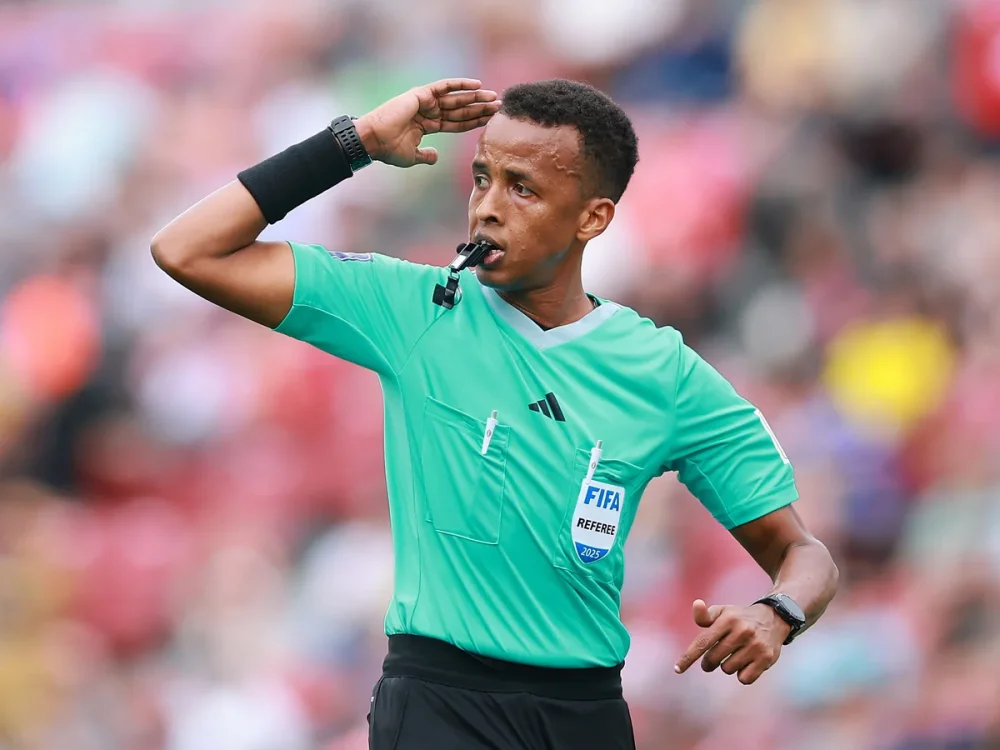
A landmark moment for Somali football has ended in disappointment after referee Omar Abdulkadir Artan was denied entry into the United States, forcing him to miss the 2026 FIFA World Cup just days before the tournament begins.
Artan had been selected among the officials chosen to oversee matches at the World Cup, which will be jointly hosted by the United States, Canada, and Mexico. His appointment was widely celebrated because it would have made him the first Somali referee in history to officiate at football’s biggest event.
Instead, his journey came to an abrupt halt upon arrival at Miami International Airport, where U.S. immigration authorities reportedly refused him entry and placed him on a return flight to Turkey.
The exact reason behind the decision has not been publicly disclosed. However, the incident has drawn attention to U.S. travel restrictions affecting citizens of several countries, including Somalia.
Somali officials confirmed that Artan possessed a valid visa and had completed the necessary travel procedures before departing for the tournament. His case has raised questions among football administrators and supporters who expected FIFA-selected officials to encounter few obstacles while traveling to a World Cup host nation.
Ciise Aden Abshir, a senior adviser at Somalia’s Ministry of Youth and Sports, strongly criticized the decision. He described Artan as one of Africa’s most respected referees and argued that excluding him from the tournament damages not only his personal career but also the principles of fairness and equal opportunity in international football.
Artan’s rise through the refereeing ranks has been remarkable. He became a FIFA-accredited referee in 2018 and has since worked at major continental competitions. In 2025, the Confederation of African Football named him African Referee of the Year, recognizing his consistency and professionalism on the field.
His selection for the 2026 World Cup was viewed as a historic achievement for Somalia, a country rarely represented at the highest levels of global football.
Reports from sources close to the referee suggest that additional complications emerged regarding the diplomatic passport he used during his travel arrangements. According to those reports, immigration officials questioned whether the passport category matched his official status.
The Somali Embassy in Kenya later stated that the diplomatic passport had been issued to facilitate visa processing and international travel linked to his World Cup duties.
Following discussions with American authorities, FIFA acknowledged that Artan would not be able to participate in the tournament. The governing body emphasized that immigration and visa decisions remain under the authority of the host country and confirmed that it had been informed the situation would not change.
The announcement effectively ended any hopes of a late resolution.
Somalia’s Football Federation has since requested further clarification from FIFA regarding the circumstances that led to Artan’s exclusion. The organization is seeking answers about how a referee officially selected for the World Cup could ultimately be prevented from taking part.
For many football fans across Africa, the story represents more than the disappointment of a single official. It highlights the complex intersection of international sport, immigration policy, and global politics.
Although Omar Artan will not take the field as a referee at the 2026 FIFA World Cup, his journey remains a significant chapter in Somali sporting history. His achievements have already inspired a new generation of officials and athletes, ensuring that his impact on African football will extend far beyond this setback.