
A new chapter is unfolding in relations between Rwanda and the United States, one defined not only by diplomacy but also by cutting-edge technology, space exploration, strategic investment and long-term economic cooperation.
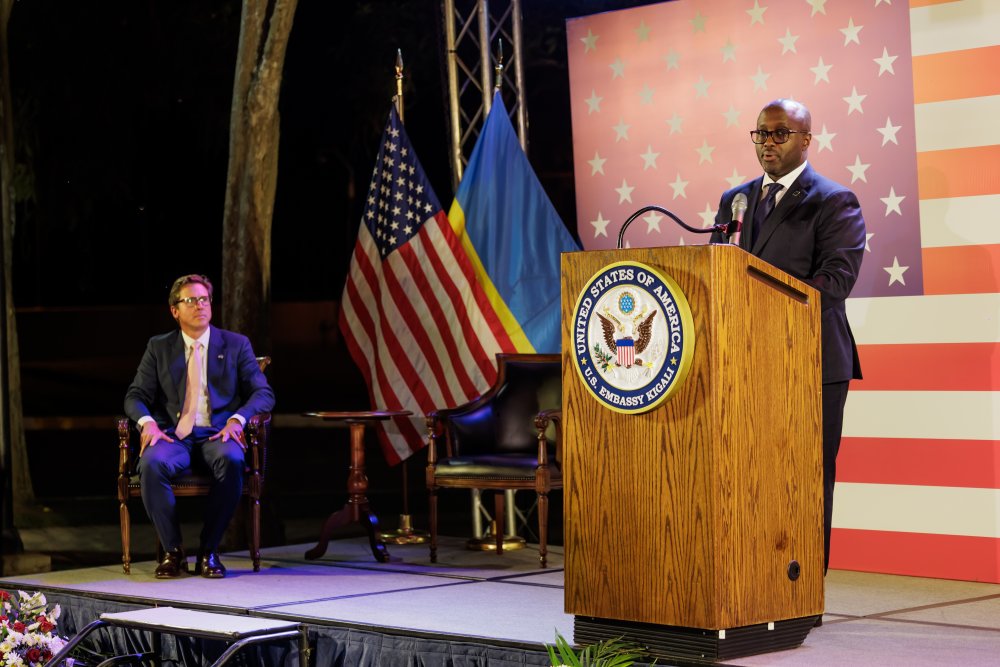
Speaking during celebrations marking the 250th anniversary of American independence, Rwanda’s Minister of Foreign Affairs and International Cooperation, Ambassador Olivier Nduhungirehe, highlighted the growing partnership between the two nations and pointed to several initiatives that are shaping the future of bilateral relations.
Among the most remarkable developments is Rwanda’s increasing engagement in global space initiatives through the Artemis Accords, an international framework established by the United States in collaboration with NASA to promote peaceful and sustainable exploration of outer space.
Rwanda joined the Artemis Accords in December 2020, becoming part of a growing coalition of countries committed to responsible space exploration and cooperation. According to Nduhungirehe, Kigali is now actively exploring practical avenues of collaboration with NASA and other member states.
“As a signatory to the Artemis Accords, Rwanda is keen to find concrete ways to collaborate with NASA and looks forward to proposing mutually beneficial joint projects that will contribute to advancing research, capacity building, and economic development,” he said
His remarks underscore Rwanda’s ambition to position itself within emerging sectors linked to scientific innovation, research and advanced technology.
The minister also referred to the recent Artemis II mission, which successfully completed a ten-day journey around Earth and near the Moon. The mission set multiple milestones, including Victor Glover becoming the first Black astronaut to travel so far into deep space, Christina Koch becoming the first woman to participate in such a mission and Jeremy Hansen becoming the first Canadian astronaut to take part in this phase of lunar exploration.
Beyond space cooperation, Rwanda and the United States are expanding collaboration in sectors expected to drive future growth.
“We continue to expand cooperation in sectors that will define the future, particularly in critical minerals, advanced technology, and nuclear energy for peaceful purposes and the development of the people.”
One significant breakthrough came through a new nuclear energy cooperation agreement signed during the Nuclear Energy Innovation Summit for Africa (NEISA) held in Kigali. The partnership includes opportunities for Rwandan students to receive specialized training in the United States, support for nuclear-related projects and broader knowledge exchange in advanced technologies.
“This milestone opens up new avenues of cooperation in energy, security, technology transfer, scientific capacity building, and innovation.”
Investment remains another pillar of the growing relationship. Rwanda welcomed continued American involvement in its mining industry, particularly through partnerships involving Trinity Metals and U.S. companies importing Rwandan tungsten products.
Technology has also become a flagship area of cooperation. Zipline, the American drone delivery company operating in Rwanda, continues to transform healthcare logistics by transporting blood, medicines and medical supplies to remote communities.
Rwanda recently became the first country to sign an agreement for the next phase of Zipline’s expansion, following a $150 million U.S. investment package aimed at strengthening the company’s operations and technological capabilities.
Health cooperation, especially in disease prevention, epidemic preparedness and public health resilience, remains a major component of the partnership.
Nduhungirehe further described 2026 as a landmark year in Rwanda-US relations because of Washington’s decision to explicitly use the term “Genocide against the Tutsi” during the annual commemoration period.
The statement issued by the U.S. Bureau of African Affairs in April declared: “During Kwibuka, we honor the victims of the Genocide against the Tutsi and remember the extreme atrocities that characterized it. The United States stands with Rwanda in unity and reconciliation, and strongly condemns any denial or minimization of the Genocide.”
Rwanda viewed this as an important recognition of historical truth and a significant contribution to global efforts against genocide denial and distortion.
“Using the exact and correct terminology is a way to respect historical truth, honor the victims and survivors, and contribute to fighting genocide, its denial, and its minimization worldwide.”
The minister also praised Washington’s involvement in diplomatic efforts aimed at restoring peace in eastern Democratic Republic of Congo and the wider Great Lakes region.
“We hope that these unbiased peace efforts address the root causes of the war and will soon bear fruit, bringing peace to Rwanda and its borders, as well as peace to the Great Lakes Region, and expanding opportunities for economic cooperation, trade, and investment.”
As the United States commemorates 250 years of independence and remains the world’s largest economy, Rwanda sees growing opportunities to deepen cooperation in innovation, trade, education, advanced technology and investment.
From NASA partnerships and lunar exploration to nuclear energy, healthcare innovation and regional peacebuilding, the relationship between Kigali and Washington is increasingly defined by shared ambitions for the future rather than traditional forms of assistance. The trajectory suggests that the next decade could become one of the most transformative periods in the history of Rwanda-US relations.