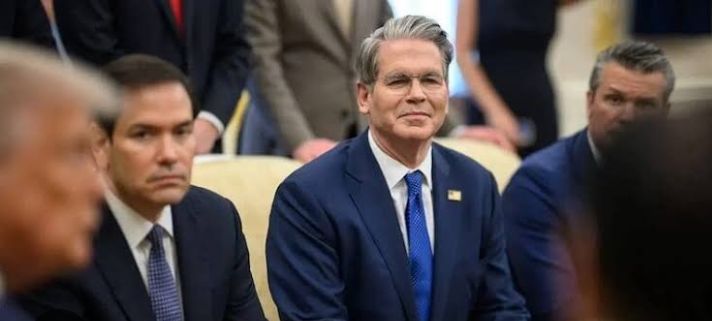
Remarks attributed to U.S. Treasury Secretary Scott Bessent concerning armed groups operating in eastern Democratic Republic of Congo have sparked renewed debate among observers of the Great Lakes region.
Among those reacting strongly is political and security analyst Girinka William Kabare, a longtime commentator on developments in eastern Congo. In a message shared with MCN, Girinka challenged the characterization of AFC/M23 and FDLR as comparable actors allegedly threatening American interests in the region.
According to Girinka, such assessments overlook the vastly different historical backgrounds, motivations, and political narratives associated with the two movements.
Reflecting on reports released this week, he questioned whether economic interests linked to Congo’s vast mineral wealth are being prioritized over the lives and rights of local communities affected by decades of conflict.
He stated: “After reading and listening to reports describing M23 and FDLR as groups threatening American interests in eastern Congo, one fundamental question comes to mind: whose interests are truly being threatened? Can the value of human life be measured against economic interests tied to mineral resources?”
Girinka argued that many international discussions fail to recognize the grievances frequently expressed by Congolese Tutsi communities in North Kivu and Banyamulenge communities in South Kivu. He said these populations have for years raised concerns about displacement, insecurity, discrimination, and disputes surrounding citizenship and land rights.
In his view, placing AFC/M23 and Twirwaneho in the same category as FDLR ignores important historical and political distinctions that continue to shape the conflict.
He further emphasized the long-standing displacement crisis affecting communities across eastern Congo.
“Many people overlook the fact that some families have spent nearly thirty years waiting to return to their homes. Some fled in 1996, while others remain internally displaced or refugees in neighboring countries. A lasting solution has yet to emerge,” he said.
The analyst also pointed to previous developments linked to the Doha peace process, noting that AFC/M23 had withdrawn from certain areas, including Uvira, following negotiations facilitated in Qatar.
For Girinka, that move demonstrated a willingness to engage in political dialogue and seek negotiated solutions.
“If the United States supported the Doha talks and the parties remain engaged in negotiations, it becomes difficult to understand why AFC/M23 would again be placed in the same category as FDLR,” he said.
Girinka argued that discussions about insecurity in eastern Congo should also examine the responsibility of state institutions. He maintained that governments bear the primary obligation to protect civilians and address the root causes of conflict.
He said: “When civilians are killed, looted, displaced, or deprived of their rights, the first question should concern the role of the state. Protecting citizens is fundamentally a government responsibility.”
He warned against approaches that focus exclusively on military considerations while neglecting deeper political and social grievances.
According to Girinka, sustainable peace will require addressing historical injustices, ensuring equal rights for all citizens, and creating conditions in which affected communities feel represented and protected.
He also expressed concern that international actors may sometimes place greater emphasis on economic and mineral interests than on the welfare of populations living in conflict zones.
Calling on Washington and other international stakeholders to reassess their understanding of eastern Congo’s crisis, Girinka urged policymakers to examine the motivations and concerns frequently cited by communities involved in the conflict.
Concluding his message, he insisted that long-term stability cannot be achieved through economic calculations alone.
“Lasting security will not come from pursuing interests alone. It will come from respecting the rights of every citizen and addressing the causes that have fueled conflict for decades. Human life must come before every other interest,” he said.
Girinka’s remarks add to an ongoing international debate about security, governance, displacement, and peacebuilding in eastern Democratic Republic of Congo, where efforts to end years of instability continue to face significant challenges.