Rwanda has hosted the seventh session of the joint Rwanda-Russia military cooperation commission, a high-level meeting that has drawn sharp reactions across the Great Lakes region, particularly in the Democratic Republic of Congo and among groups opposed to the government in Kigali.
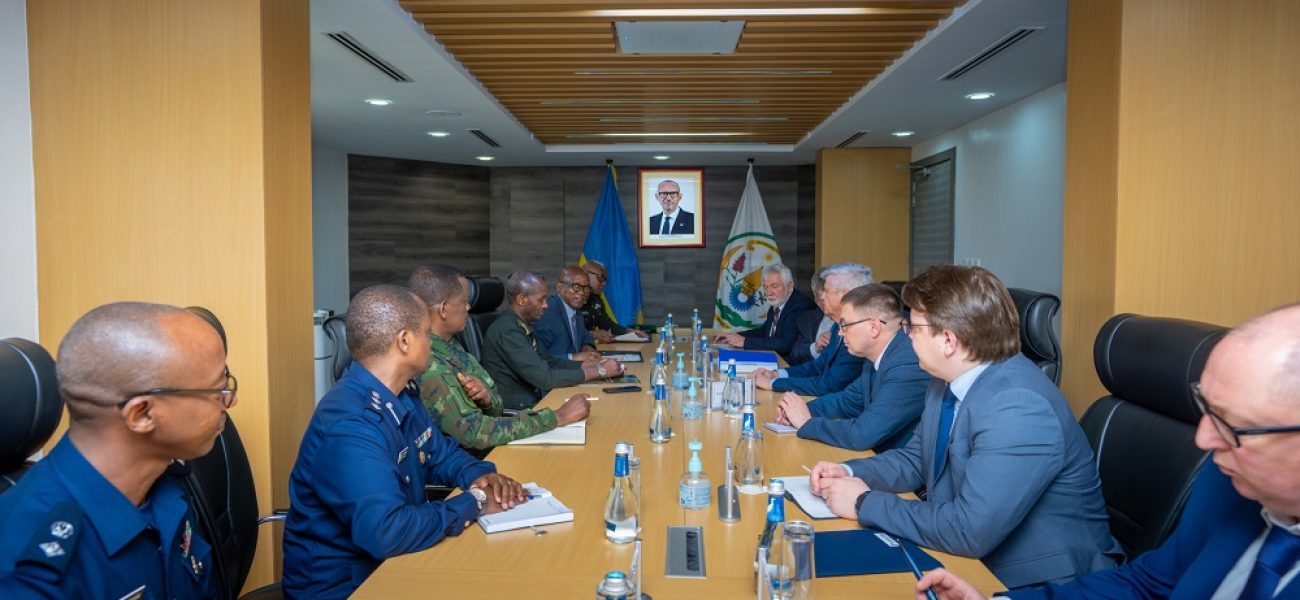
The three-day meeting, taking place in Kigali from May 20 to May 22, 2026, brought together senior military officials from both countries to review ongoing defense cooperation and explore new strategic areas of partnership.
The Rwandan delegation is led by Brig. Gen. Patrick Karuretwa, Director General for International Military Cooperation at the Ministry of Defence, while the Russian side is headed by Anatoly Punchuk, Deputy Director of Russia’s federal agency responsible for military cooperation.
During their visit, Russian officials also held discussions with Rwanda’s Minister of Defence, Juvenal Marizamunda, and the Chief of Defence Staff of the Rwanda Defence Force, Gen MK Mubarakh, focusing on priority areas of military collaboration between Kigali and Moscow.
While the meeting was officially presented as a routine annual engagement, reactions from regional media outlets and political commentators suggest it carries much deeper geopolitical significance.
Media organizations aligned with authorities in the Democratic Republic of Congo and Burundi portrayed the meeting as a troubling signal that Russia is strengthening ties with Rwanda at a time of heightened regional tensions linked to the conflict in eastern Congo.
In Kinshasa, some political voices close to President Felix Tshisekedi’s administration expressed frustration after realizing that Moscow continues to deepen military relations with Kigali despite Congo’s own defense agreements with Russia.
On social media platform X, several Congolese commentators openly questioned Russia’s strategic intentions. Some posts asked, “Is Russia abandoning us?” while others criticized what they described as unrealistic expectations that Moscow would automatically side with Kinshasa against Rwanda.
Security analysts in the region also pointed to growing fears that Rwanda could gain access to advanced Russian military technologies, including air defense systems, military communications infrastructure and other strategic capabilities that could further strengthen the Rwanda Defence Force.
Such concerns are especially significant for Congolese officials who have invested heavily in combat aircraft and drone capabilities in recent years. Analysts fear that enhanced Rwandan air defense systems could reduce the effectiveness of those assets in any future confrontation.
In neighboring Burundi, commentators monitoring regional security developments similarly warned that closer military relations between Kigali and Moscow could alter the balance of power in the Great Lakes region.
The meeting also dealt a blow to narratives promoted by Rwandan opposition figures abroad who have long argued that Kigali is becoming internationally isolated because of accusations linked to the conflict in eastern Congo.
Supporters of opposition movements associated with former military figures and political dissidents have frequently used platforms such as YouTube and X to argue that Rwanda was losing diplomatic allies. However, Russia’s continued military engagement with Kigali has undermined those claims.
Political observers noted that Russia’s permanent veto power at the United Nations Security Council gives its partnerships additional geopolitical weight, making Rwanda’s relationship with Moscow strategically important beyond the military sphere alone.
Some analysts also connected the growing ties to broader cooperation projects between Rwanda and Russia, including discussions involving nuclear energy development through Russia’s state nuclear corporation Rosatom.
Although no detailed resolutions from the commission have yet been made public, the continued high-level engagement between the two countries is being interpreted as a sign that military relations between Kigali and Moscow are steadily expanding.
For Rwanda’s regional rivals and political opponents, the symbolism of Russian officials meeting senior RDF commanders in Kigali may prove just as significant as any agreements signed behind closed doors.