
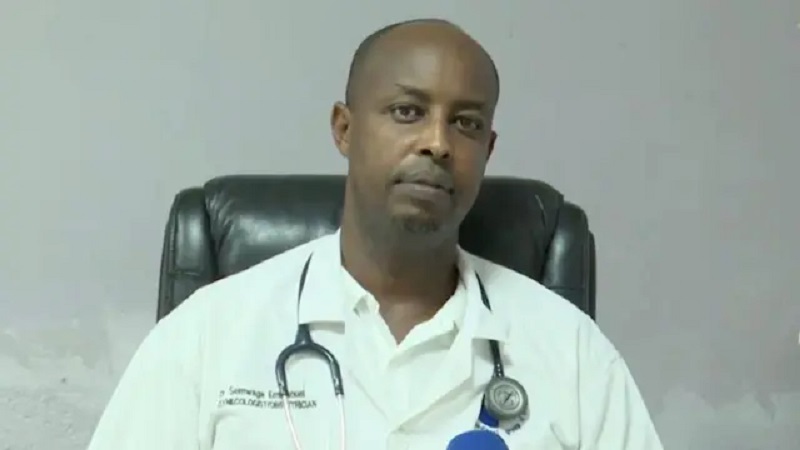
A growing legal scandal surrounding fertility services and surrogate motherhood in Rwanda has placed Dr. Semwaga Emmanuel, a well-known gynecologist and fertility specialist, at the center of one of the country’s most controversial criminal investigations in recent years.
The doctor, who had reportedly spent nearly a decade helping couples struggling with infertility, is now facing serious criminal accusations tied to an alleged surrogacy operation authorities believe crossed the line into human trafficking and exploitation.
The case also involves Frederick Nsabimana and his wife, Gerardine Mukahigiro, who are accused of organizing and managing a private arrangement that connected women willing to carry pregnancies with clients living both inside and outside Rwanda.
Investigations indicate that Nsabimana had rented a residence where several young women were housed after undergoing embryo implantation procedures. According to information emerging from the case file, the women were expected to remain there until childbirth.
Seven women were reportedly recruited into the arrangement. Some of the intended parents seeking surrogacy services were said to be living abroad, including in the United States, Tanzania and Uganda.
Each woman had allegedly been promised payment amounting to five million Rwandan francs. However, prosecutors claim only a small advance was initially provided, while significant deductions were made under the guise of commissions and living expenses.
What began as an arrangement presented as assistance to childless families gradually turned into allegations of abuse, intimidation and exploitation.
Several of the women reportedly complained about harsh living conditions inside the residence, claiming they suffered from hunger, poor treatment and lack of proper financial support despite the large sums that had allegedly been paid by clients.
The case escalated further after accusations emerged that threats were used to silence complaints. Investigators say some women reported being warned that they could be harmed if they continued speaking about their conditions.
Mukahigiro, the wife of Nsabimana, is also accused of intimidating the women when they raised concerns about their treatment and welfare.
Authorities later discovered that injections and medication were allegedly being administered inside the residence itself. Nsabimana reportedly defended the practice by claiming that medical professionals from a clinic were sent to provide treatment and medication.
Local leaders reportedly told investigators they had no knowledge that women involved in surrogacy arrangements were being housed in the residence under questionable conditions. That revelation added further accusations related to unlawful confinement.
The operation finally came under scrutiny on April 29, 2026, after some of the women reported their living conditions to authorities. Government officials who visited the property reportedly found five women already pregnant while two others were still preparing for embryo implantation.
Prosecutors argue that Dr. Semwaga played a critical role in the medical side of the operation.
Both the doctor and Nsabimana acknowledged knowing each other before the scandal emerged. Their relationship reportedly began after Dr. Semwaga successfully helped a member of Nsabimana’s family give birth through fertility treatment.
Authorities accuse the physician of carrying out embryo implantation procedures even when the intended parents were not physically present, something prosecutors say violated Rwanda’s medical regulations governing assisted reproductive services.
Nsabimana defended the arrangement by claiming he had been formally authorized to represent the intended parents, many of whom lived abroad and could not personally supervise the procedures.
The prosecution also alleges that Dr. Semwaga transferred money to Nsabimana to support the pregnant women, describing those payments as evidence of collaboration in the broader scheme.
Investigators further argue that the doctor ignored complaints from some of the women regarding unpaid compensation and poor living conditions.
Dr. Semwaga, however, denied any criminal intent. He reportedly told investigators that the money he provided was merely a temporary loan after being informed that funds from the intended parents had been delayed. According to his explanation, he feared the pregnant women and unborn children could face serious hardship without food or medical support.
Another major accusation concerns the use of identification “codes” assigned to unborn babies. Prosecutors claim the codes linked pregnancies to intended parents who had never met the surrogate mothers, allegedly creating falsified medical documentation.
The doctor maintains that such coding systems are common in fertility medicine and were only intended to avoid confusion between cases.
On May 26, 2026, the Kicukiro Primary Court rejected requests by Dr. Semwaga, Nsabimana and Mukahigiro to be released on provisional bail.
The suspects had argued they would not flee justice, interfere with investigations or abandon the pregnant women involved in the case. Dr. Semwaga even offered a financial guarantee of 20 million Rwandan francs, but the court ruled that the conditions for temporary release had not been met.
The scandal has also drawn national attention to Rwanda’s relatively new law regulating reproductive health and assisted fertility services, adopted in September 2025.
The legislation established strict conditions for surrogate motherhood, including age requirements, mandatory medical evaluations and legally notarized agreements between intended parents and surrogate mothers.
Under the law, fertility specialists can face severe criminal penalties for violating medical procedures related to embryo implantation, donor identification and reproductive technologies.
Punishments range from heavy fines to prison sentences of up to 25 years depending on the gravity of the offense.
As investigations continue, the case has sparked wider debate across Rwanda about the ethical boundaries of surrogacy, reproductive medicine and the risk of turning vulnerable women into targets for commercial exploitation under the cover of fertility assistance.