
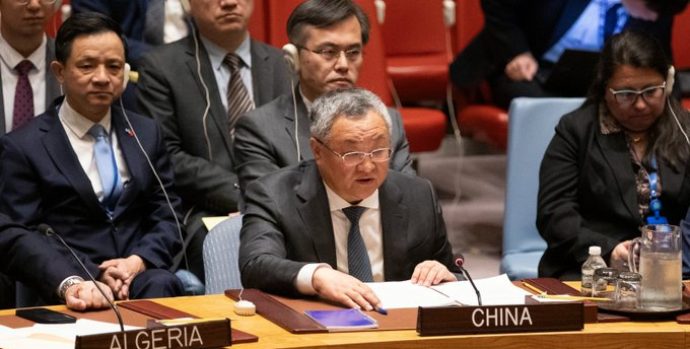
China has delivered one of its clearest messages yet on the ongoing crisis in eastern Democratic Republic of Congo, urging global powers not to turn the country’s vast mineral wealth into a geopolitical bargaining chip while simultaneously reaffirming its support for Congolese sovereignty.
The message was delivered by China’s Permanent Representative to the United Nations, Fu Cong, during a meeting of the UN Security Council focused on the deteriorating security situation in eastern DR Congo.
Addressing council members, Fu Cong argued that the challenges facing Congo extend beyond armed conflict and now include public health concerns such as recurring Ebola outbreaks. He stressed that the international community must work together to address the root causes of instability rather than merely responding to its consequences.
According to the Chinese envoy, one of the major drivers of conflict remains the illegal exploitation and trafficking of Congo’s natural resources, which continue to fuel violence and enrich armed actors operating across the region.
“The root causes of these conflicts must be resolved in a swift and comprehensive manner. The vast natural resources of the DRC should be the foundation for the country’s development, but they are plundered by armed groups and serve as a source of conflict through illegal trade.”
Beijing maintains that sustainable peace in Congo requires stronger governance in the mining sector, enhanced regional cooperation, and greater transparency in mineral supply chains. Chinese officials believe that cutting off illicit mineral trade would reduce incentives for armed conflict and allow local populations to benefit more directly from their country’s natural wealth.
Fu Cong also called on the UN Security Council to continue supporting regional institutions and mechanisms aimed at improving oversight of mineral exports and tracking the origins of resources leaving conflict-prone areas.
His strongest remarks, however, were directed at major powers outside the Great Lakes region.
“Major countries from outside this region should refrain from treating natural resources as a bargaining chip for geopolitical trade-offs. Open cooperation should be promoted, free from zero-sum competition, so that citizens can benefit from the natural resources of their own countries.”
The statement comes at a time when diplomatic efforts aimed at restoring peace in eastern Congo have intensified. The United States has played a central role in facilitating discussions between regional actors and has also concluded agreements with Kinshasa related to strategic minerals. Reports have suggested that access to mining opportunities forms part of broader economic cooperation between Washington and the Congolese government.
Beyond the minerals debate, China’s position on the broader Rwanda-DR Congo dispute has become increasingly visible throughout 2026.
At the international level, Beijing has consistently backed the sovereignty and territorial integrity of DR Congo. Within UN discussions, Chinese representatives have supported calls for Rwanda to comply with UN recommendations regarding allegations of military involvement in Congolese territory and support for the M23 movement. China has also repeatedly urged M23 fighters to halt military operations and withdraw from contested areas.
Yet China’s approach remains carefully balanced.
The country has substantial economic interests in DR Congo, particularly in cobalt and copper mining, sectors that are crucial to global manufacturing and energy transition industries. Stability in Congo is therefore considered essential for protecting long-term Chinese investments.
At the same time, Beijing has maintained strong economic and diplomatic relations with Rwanda. Trade between the two countries has continued to expand in 2026, with China emerging as one of the most important destinations for Rwandan exports and a key development partner.
Recent engagements between Chinese diplomats in Kigali and Rwanda’s Parliament have further underscored efforts to deepen cooperation in technology, trade, and economic development.
China has also repeatedly emphasized that lasting peace should emerge through African-led dialogue processes. Officials frequently point to initiatives launched in Luanda, Doha, and Washington as examples of diplomatic pathways capable of reducing tensions without escalating confrontation or imposing punitive measures.
Political analysts say China is pursuing a delicate balancing act. While firmly supporting DR Congo’s sovereignty and calling for better protection of its natural resources, Beijing is equally determined to preserve its strategic partnership with Rwanda, a country viewed as an important economic and political actor in the Great Lakes region.
The result is a diplomatic strategy that seeks to protect Chinese investments, maintain regional relationships, and encourage negotiated solutions to one of Africa’s most complex and enduring conflicts.