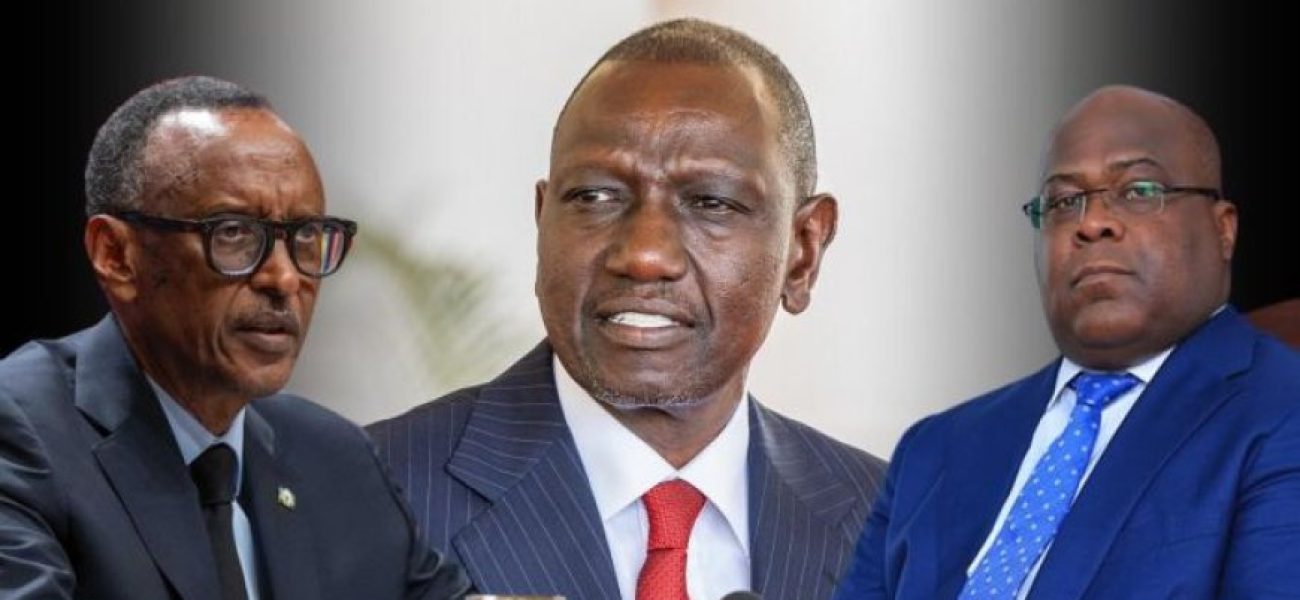
Kenyan President William Ruto has once again argued that the M23 crisis should be handled as an internal Congolese issue rather than being blamed on Rwanda, insisting that the rebel movement is made up of Congolese citizens who deserve political dialogue with their own government.
Ruto made the remarks during the Africa CEO Summit held in Kigali, where regional leaders and business executives discussed security, governance and economic cooperation across Africa.
Speaking about the long-running conflict in eastern Democratic Republic of Congo, Ruto said regional heads of state had repeatedly asked one central question: whether M23 fighters are Rwandan or Congolese. According to him, even the Congolese government recognizes them as Congolese citizens.
He stated: “As heads of state, we asked ourselves: Are M23 fighters Rwandans or Congolese? The DRC says they are Congolese. If they are Congolese, then how does it become Rwanda’s problem? How does it become Paul Kagame’s problem?”
The comments come at a time when the Congolese government continues accusing Rwanda of supporting M23, allegations Kigali has consistently denied.
Rwandan President Paul Kagame has also repeatedly maintained that M23 fighters are Congolese citizens whose grievances should be addressed through political negotiations with Kinshasa rather than through military confrontation or external accusations.
Fighting between M23 and Congolese government forces intensified again in early 2025 after the group launched rapid offensives that enabled it to capture several strategic areas, including the city of Goma. The escalation pushed the eastern Congo crisis back into the international spotlight.
The roots of the conflict remain deeply connected to the aftermath of the 1994 Genocide against the Tutsi in Rwanda, which destabilized the wider Great Lakes region. Rwanda has long accused the FDLR militia, composed largely of individuals linked to the genocide and their supporters, of collaborating with Congolese forces and threatening Rwanda’s national security.
As part of ongoing peace efforts, Rwanda and the Democratic Republic of Congo recently signed a peace agreement in the United States with mediation support from both the United States and Qatar. The agreement focused on security cooperation, economic collaboration and measures aimed at reducing tensions between the two neighboring countries.
The deal also included provisions concerning the withdrawal of Rwandan troops allegedly operating inside Congo, although Kigali has continued to deny having forces deployed there.
Despite temporary calm in some areas, clashes continued in parts of eastern Congo, prompting the United States to impose sanctions on senior Rwandan military officials accused of supporting M23 operations.
Ruto insisted that as long as M23 is officially recognized as a Congolese movement, its demands should be resolved through Congolese-led political dialogue.
He said: “Since it has already been established that M23 members are Congolese, this is a Congolese problem and it requires a Congolese solution.”
The Kenyan leader also emphasized that both the Luanda and Nairobi peace processes demonstrated the importance of including all parties in negotiations, including M23 itself.
He added: “M23 is asking, ‘Why are we excluded from negotiations? We are Congolese, we have grievances, and we want to talk to our government.’”
Ruto concluded by warning that refusing dialogue with armed groups claiming political grievances could prolong instability in the region.
According to him, no country loses anything by opening discussions with its own citizens who say they have unresolved political concerns.
He concluded: “A country loses nothing by agreeing to talk to its citizens who have grievances.”