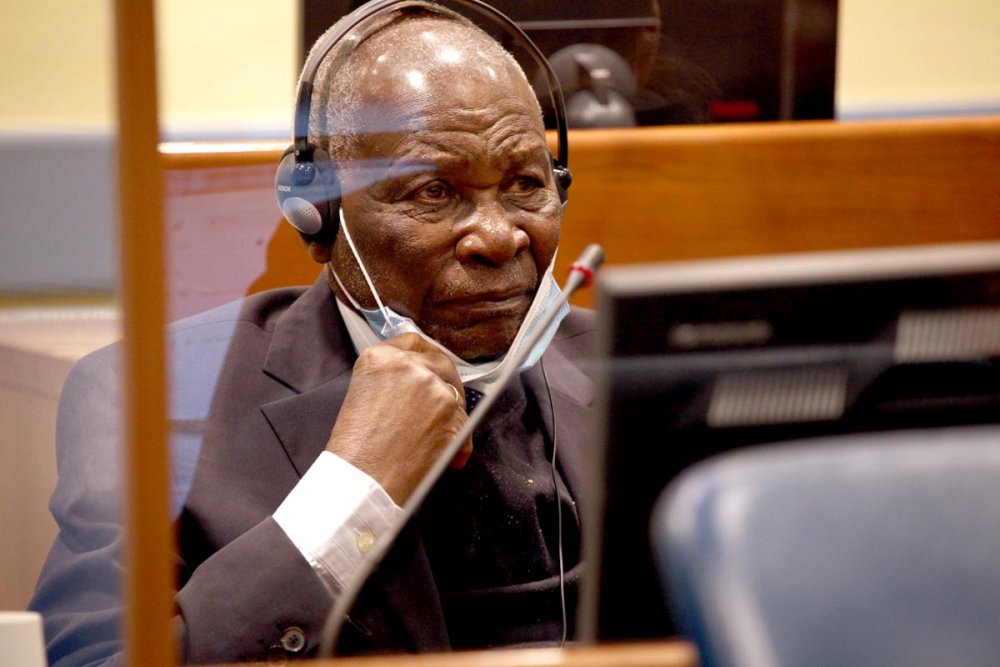
Félicien Kabuga, one of the most wanted genocide suspects in modern history, died on May 16, 2026 in The Hague, exactly six years after his arrest in France ended more than two decades of international pursuit.
His death was confirmed by the International Residual Mechanism for Criminal Tribunals (IRMCT), which announced that an investigation would be conducted to determine the exact circumstances surrounding his passing. IRMCT President Graciela Gatti Santana appointed Judge Alphons Orie to oversee the inquiry.
Kabuga had spent recent years in declining health while under detention in the Netherlands. Lawyers and medical experts repeatedly argued that severe dementia and age-related complications had rendered him mentally unfit to stand trial.
The former Rwandan businessman was arrested on May 16, 2020 in Asnières-sur-Seine near Paris after evading international justice for more than 25 years. His capture shocked many observers who had long believed he was protected by powerful networks and vast financial resources.
Kabuga faced charges including genocide, conspiracy to commit genocide, and direct incitement related to the 1994 Genocide against the Tutsi.
Prosecutors accused him of financing Radio Télévision Libre des Mille Collines (RTLM), the notorious broadcaster that spread anti-Tutsi propaganda and encouraged mass killings during the genocide.
He was also accused of helping import and distribute machetes and other weapons allegedly used during the massacres that killed more than one million people in 100 days.
According to prosecutors, Kabuga worked closely with senior officials of the former government and Interahamwe militias in organizing and financing the violence across Rwanda.
Although proceedings against him officially began in 2022, the case was suspended in 2023 after independent medical evaluations concluded that he was no longer capable of meaningfully participating in his defense.
Following news of his death, Ibuka President Dr. Philbert Gakwenzire told Rwanda Broadcasting Agency that Kabuga left behind what he described as a legacy of using money and influence to facilitate violence and evade accountability.
He alleged that Kabuga not only benefited from political protection linked to his close relationship with former President Juvénal Habyarimana, but also spent heavily to silence people attempting to track him down.
“One known fact is that people who tried to pursue him were killed because he used his money to spread corruption in many places until his arrest in 2020,” Dr. Gakwenzire said.
One of the most widely discussed cases involved Kenyan investigative journalist William Munuhe Gichuki.
Munuhe reportedly discovered Kabuga’s whereabouts and began cooperating with FBI investigators pursuing genocide suspects. He hoped to claim the $5 million reward offered for information leading to Kabuga’s arrest.
On January 14, 2003, Munuhe was expected to help authorities capture Kabuga after reportedly meeting him inside his residence. But the operation never materialized.
Three days later, after failing to hear from him, FBI investigators forced their way into the rented house where they found him dead in horrifying circumstances.
He had been shot multiple times, his eyes removed, and acid poured onto his face.
Dr. Gakwenzire said the killing reflected how wealth could be weaponized to protect impunity and eliminate perceived threats.
He argued that Kabuga’s story demonstrated how money without moral responsibility can become a destructive force, especially when tied to crimes connected to the genocide against the Tutsi.
Kabuga’s death closes one of the longest-running international manhunts linked to the 1994 genocide, but it also revives difficult questions about how he managed to evade capture for decades and whether financial influence helped shield him from justice for so long.