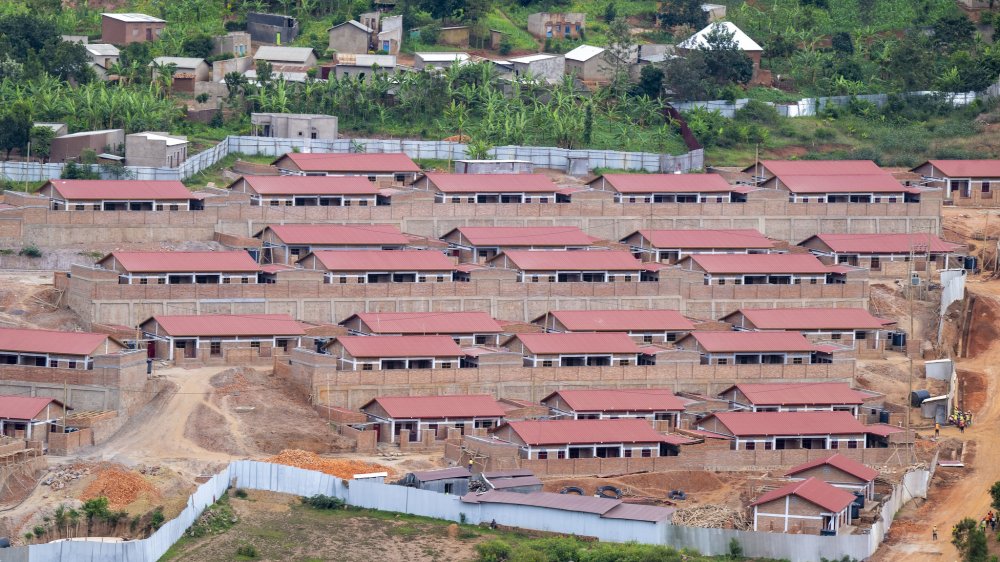
The Government of Rwanda has announced a temporary suspension of its Model Village construction program as authorities undertake a comprehensive review aimed at improving the effectiveness, affordability, and relevance of future housing developments.
The announcement was made on June 16, 2026, by Finance and Economic Planning Minister Yusuf Murangwa during a parliamentary session where lawmakers began examining the proposed national budget for the 2026/2027 fiscal year.
The issue emerged after Member of Parliament Speciose Mukandaga questioned why several projects included in the 2025/2026 budget had either received reduced funding or disappeared entirely from the new budget proposal.
Among the projects she highlighted was a Model Village initiative planned for the districts of Nyagatare, Gicumbi, and Musanze. The project had initially been allocated RWF 500 million in the draft budget but was no longer listed in the new spending plan.
Mukandaga expressed concern about the potential impact on activities that had already begun, noting that projects previously approved and funded appeared to have been removed without clear explanation.
Responding to lawmakers, Minister Murangwa explained that some public projects undergo revisions after implementation reveals weaknesses in the original planning process. According to him, the Model Village program has reached a stage where authorities believe improvements can be made before expanding further.
He stated that the government wants future projects to deliver better value while responding more directly to the real needs of residents.
Murangwa noted that in some cases houses were constructed only to discover that they did not fully correspond to what local communities actually required. At the same time, certain essential services needed by residents had not been adequately incorporated into the original plans.
As a result, the government is reviewing both the design and strategic direction of future Model Villages before committing additional resources.
The Model Village program has been one of Rwanda’s flagship housing and settlement initiatives over the past decade. It has primarily served vulnerable families relocated from high-risk zones, disaster-prone areas, and locations earmarked for public infrastructure projects.
Beyond housing, the villages have been designed as integrated communities that combine homes with schools, health facilities, roads, electricity, clean water systems, and other essential services.
Data from Rwanda’s 2022 Population and Housing Census showed that 65 percent of the population lives in grouped settlements, reflecting the country’s long-term strategy of promoting organized and planned communities.
Government statistics indicate that between 2017 and 2024, Rwanda constructed 87 model villages that provided housing for more than 17,000 families. The number of model villages nationwide has now surpassed 250, representing significant growth over recent years.
Although new construction has been paused for the moment, officials insist that Rwanda’s commitment to improving housing conditions remains unchanged. The review process is intended to ensure that future developments are more responsive to community priorities, more cost-effective, and better integrated with essential social services.
Urban development experts argue that periodic evaluations of large-scale public housing programs are necessary to maximize public investment and ensure that infrastructure projects genuinely address local needs rather than applying a one-size-fits-all approach.
The ongoing review is expected to shape the next generation of Rwanda’s Model Villages, potentially creating communities that are not only better planned but also more closely aligned with the expectations and everyday realities of the people they are intended to serve.