The race to lead the International Organization of La Francophonie (OIF) has entered a crucial phase after candidates presented their visions before ministers representing member states in Paris, with Rwanda’s Foreign Affairs Minister Olivier Nduhungirehe stating that a noticeable gap emerged between incumbent Secretary-General Louise Mushikiwabo and her competitors.
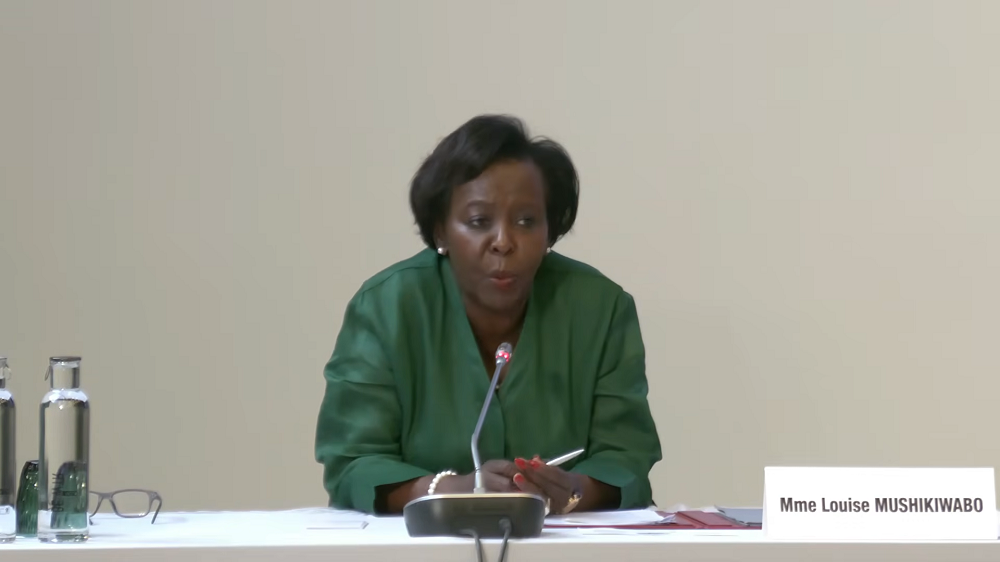
The high-level session took place on June 30, 2026, bringing together members of the Francophonie Ministerial Conference (CMF) to hear directly from candidates seeking to guide the future of the organization, which unites French-speaking countries across several continents.
Four candidates are competing for the position: incumbent Secretary-General Louise Mushikiwabo of Rwanda, Juliana Amato Lumumba of the Democratic Republic of Congo, Coumba Ba of Mauritania, and Dacian Ciolos of Romania.
According to Nduhungirehe, the event marked a historic first for the organization. The candidate hearing process was introduced as part of governance reforms implemented during Mushikiwabo’s tenure, aimed at increasing transparency and allowing member states to evaluate candidates more thoroughly before voting.
Representatives from 49 member countries attended the gathering, including 23 ministers. Three candidates participated in person, while Juliana Amato Lumumba joined virtually through video conferencing technology.
Each contender was given twenty minutes to present their program and priorities, followed by a thirty-minute question-and-answer session with ministers. The format allowed delegates to assess leadership skills, policy proposals, diplomatic experience, and strategic vision for the future of the Francophonie.
Nduhungirehe emphasized that the atmosphere remained respectful and constructive throughout the proceedings. He noted that ministers appreciated the quality of the discussions and that no confrontational exchanges occurred among candidates or between member states.
Reflecting on the event, he stated: “These people were also able to converse with courtesy and mutual respect during a reception hosted by the President of the CMF from Cambodia.”
The Rwandan minister also indicated that many participants observed a significant distinction in experience and preparedness among the candidates.
He said: “However, everyone observed a stark contrast on one hand between the experience, competence, and skill of Louise Mushikiwabo in handling dossiers and that of the other three competing candidates. Nevertheless, this does not take away from the genuine visions that all the candidates were able to present to our shared organization.”
His remarks suggest that Mushikiwabo’s years of experience at the helm of the organization have strengthened her profile ahead of the decisive vote.
Since assuming office in 2019, she has overseen reforms focused on institutional modernization, youth engagement, digital transformation, and strengthening the relevance of the Francophonie in global affairs.
At the same time, the other candidates used the platform to present their own visions for the organization.
Their proposals addressed issues ranging from expanding Africa’s role within the Francophonie to fostering economic cooperation, supporting sustainable development, and responding to emerging global challenges.
The next major milestone in the election process will be the Summit of Heads of State and Government scheduled for November 15–16, 2026, in Phnom Penh, Cambodia.
During that summit, member states will choose the next Secretary-General, a decision that will shape the direction of the Francophonie for years to come. With only a few months remaining before the vote, attention is increasingly turning toward the candidates’ ability to convince member governments that they possess the leadership needed for the organization’s next chapter.
Nduhungirehe’s comments have added further momentum to discussions surrounding Mushikiwabo’s candidacy, reinforcing perceptions among many observers that she remains one of the strongest contenders in the race to lead the Francophonie.