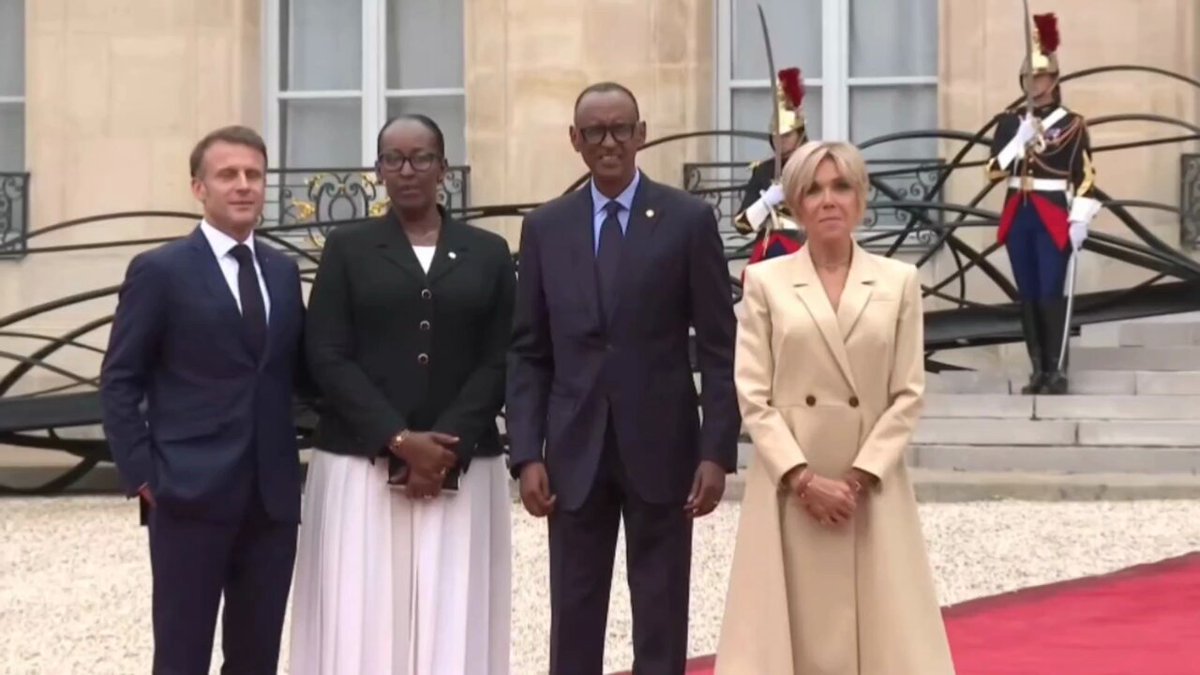
President Paul Kagame and First Lady Jeannette Kagame’s visit to France has attracted significant international attention, not only because of the official events on the agenda but also because of its broader historical and diplomatic significance.
The Rwandan presidential couple arrived in Paris to participate in the inauguration of a new memorial dedicated to the victims of the 1994 Genocide against the Tutsi. While the ceremony itself marked an important moment of remembrance, it also reflected the continuing transformation of relations between Rwanda and France.
On June 2, 2026, President Kagame and French President Emmanuel Macron officially unveiled the memorial in the heart of Paris. The monument, known as “Les Archives,” was developed through a partnership involving the French Government, the City of Paris, and Ibuka France.
Created by internationally acclaimed Portuguese artist Grada Kilomba, the memorial stands at Habib-Bourguiba Esplanade overlooking the Seine River. Its design features two opposing rectangular structures symbolizing memory, dialogue, and the preservation of historical truth.
The site is intended to serve as a permanent place of remembrance for the more than one million men, women, and children who were killed during the Genocide against the Tutsi between April and July 1994.
Inscribed in French, English, Kinyarwanda, and Swahili, the memorial honors the victims, survivors, and the enduring responsibility to preserve the memory of what happened. It is expected to become an important educational and commemorative space for future generations.
Beyond its symbolic value, the memorial represents a major milestone in the evolving relationship between Rwanda and France. For decades, the two countries experienced tensions rooted in differing interpretations of historical events surrounding the genocide.
In recent years, however, both governments have taken steps toward reconciliation based on historical research, acknowledgment of past failures, and a shared commitment to truth.
The Élysée Palace described the inauguration as an opportunity to reinforce years of reconciliation efforts and to continue promoting historical understanding. French officials also linked the event to President Macron’s landmark visit to Rwanda on May 27, 2021.
During that visit to the Kigali Genocide Memorial, Macron acknowledged that France had failed to recognize the warning signs that pointed toward the preparation of genocide and admitted that France had continued supporting the government of President Juvénal Habyarimana despite growing evidence of the danger facing the Tutsi population.
Those remarks were widely viewed as a turning point in relations between the two countries and helped create a foundation for deeper cooperation.
Observers note that seeing Kagame and Macron standing together to inaugurate a genocide memorial in Paris carries powerful symbolism. It reflects a journey from historical tensions toward mutual recognition, remembrance, and partnership.
The visit also included diplomatic engagements. Following the memorial inauguration, President Kagame and First Lady Jeannette Kagame were hosted by President Macron and First Lady Brigitte Macron at the Élysée Palace, underscoring the growing warmth in bilateral relations.
Today, Rwanda and France cooperate across multiple sectors, including education, technology, culture, trade, and investment. The Paris memorial further strengthens that partnership while reinforcing the global commitment to combat genocide denial and preserve historical memory.
Ultimately, the deeper significance of this historic visit extends far beyond the unveiling of a monument. It represents an ongoing effort to honor victims, amplify the voices of survivors, confront difficult historical truths, and build a future founded on respect, understanding, and shared responsibility.
More than three decades after the Genocide against the Tutsi, the ceremony in Paris stands as a reminder that remembrance, truth, and justice remain essential pillars in shaping international relations and safeguarding humanity from repeating the tragedies of the past.