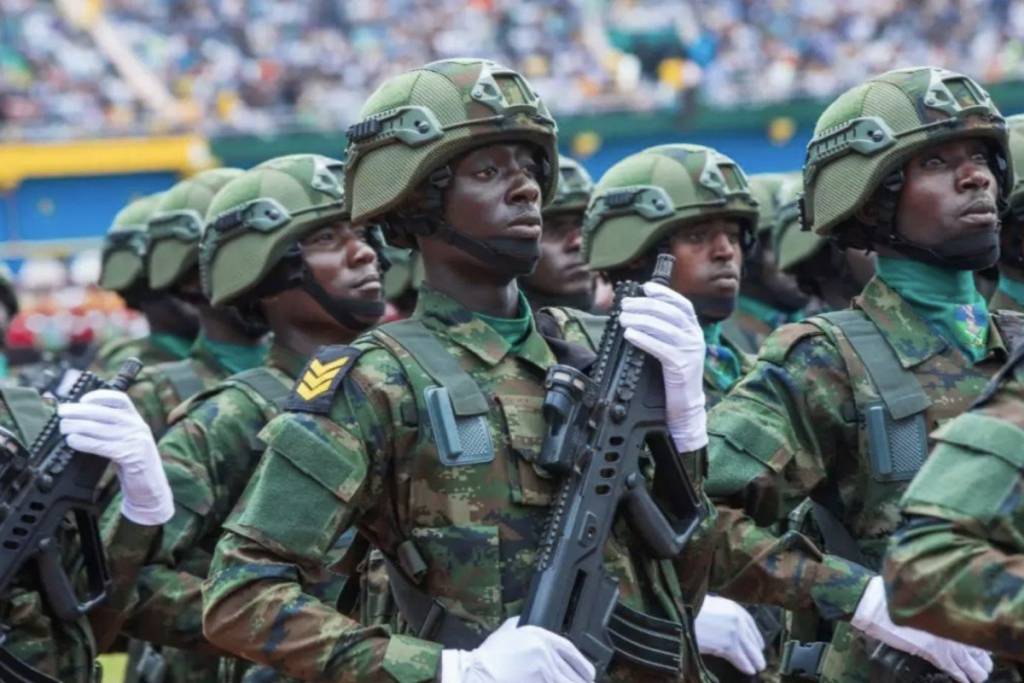
Rwanda has launched a renewed diplomatic push aimed at convincing the United States to lift sanctions imposed on the Rwanda Defence Force (RDF), as Kigali continues to reject allegations linking its military to the M23 rebellion in eastern Democratic Republic of Congo.
The sanctions, announced by Washington on March 2, 2026, targeted several senior RDF commanders as well as the institution itself. U.S. authorities argued that the measures were connected to allegations of support for M23, a movement that has remained at the center of the conflict in eastern Congo.
Rwanda has consistently denied those accusations, maintaining that M23 is a Congolese movement born out of long-standing grievances inside the DRC and that Kigali should not be blamed for internal Congolese political and security challenges.
Among the officials sanctioned were RDF Chief of Defence Staff General Mubarakh Muganga, Commander of Land Forces Major General Vincent Nyakarundi, Special Operations Commander Brigadier General Stanislas Gashugi, and Major General Ruki Karusisi, who leads the Fifth Division of the RDF.
The sanctions include restrictions on assets located in the United States or controlled through U.S.-linked financial systems, placing them under the authority of the Office of Foreign Assets Control (OFAC).
Speaking in an interview with journalist Ally Soudy, Rwanda’s Ambassador to the United States, Mathilde Mukantabana, argued that any serious discussion about insecurity in eastern Congo must take into account the legacy of the 1994 Genocide against the Tutsi and the continued presence of extremist forces linked to that history.
According to the ambassador, the ideology that fueled the genocide did not disappear after 1994 but spread across borders, contributing to instability and violence in neighboring regions, particularly in eastern Congo.
For years, Rwanda has pointed to the continued presence of the FDLR, a group linked to perpetrators of the genocide against the Tutsi, as a major security threat. Kigali maintains that lasting peace in eastern Congo will remain difficult to achieve as long as armed groups such as the FDLR continue to operate freely.
Mukantabana emphasized that the sanctions have not damaged the broader relationship between Rwanda and the United States. Instead, she described them as an issue that remains under discussion through diplomatic channels.
She indicated that Rwanda continues to engage American policymakers, institutions, and partners in an effort to explain its position and demonstrate what it views as an incomplete understanding of the conflict.
The ambassador also noted that some voices within the United States believe the sanctions were unjustified and that continued dialogue could eventually lead to a reassessment of Washington’s position.
Her comments come at a time when regional peace efforts remain fragile despite agreements signed between Rwanda and the DRC with U.S. support. While the peace framework signed in June 2025 was welcomed internationally, disagreements over implementation have continued to generate tensions between the two neighboring countries.
Rwanda insists it remains committed to honoring its obligations under those agreements, including the eventual removal of defensive security measures, provided that Congolese authorities take effective action against the FDLR and other armed groups threatening regional stability.
As diplomatic engagement continues, Rwanda appears determined not only to seek the lifting of sanctions but also to reshape international understanding of the conflict.
Kigali argues that sustainable peace will require addressing the underlying drivers of insecurity in eastern Congo rather than focusing solely on accusations directed at neighboring states. With regional stability still at stake, the outcome of these diplomatic efforts could influence not only Rwanda-U.S. relations but also the broader search for peace in the Great Lakes region.