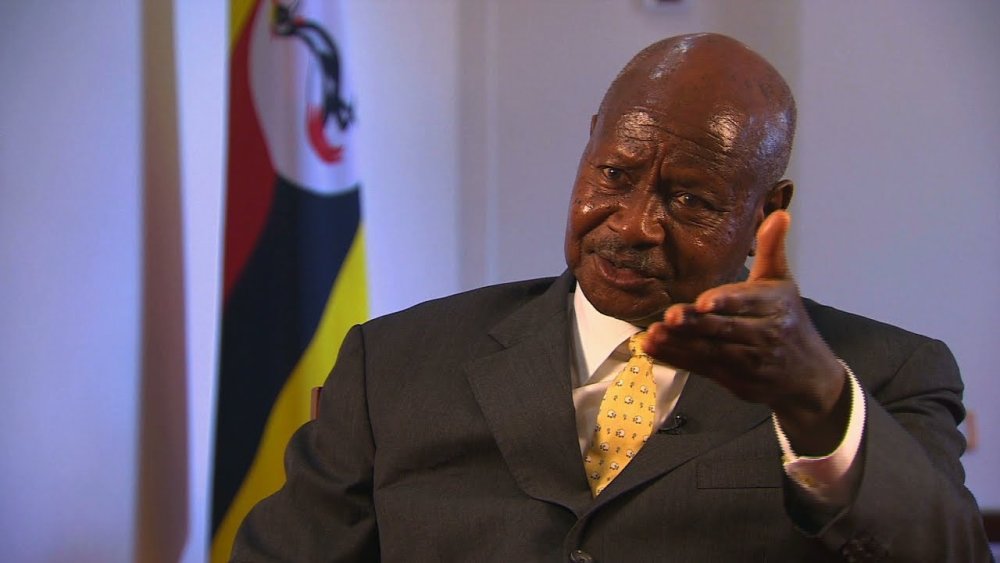
A growing political fallout between Ugandan President Yoweri Kaguta Museveni and veteran journalist Andrew Mwenda has sparked intense debate across Uganda after Mwenda openly questioned the president’s ability to continue leading the country.
Mwenda, long known as a close ally of Museveni’s family and particularly of his son Muhoozi Kainerugaba, has in recent years occasionally criticized government decisions. However, his latest remarks marked one of the strongest public attacks he has ever directed at the Ugandan leader.
On May 13, 2026, Mwenda argued that there was a major contradiction between Museveni’s speeches and his actions, saying: “One thing I have noticed about President Museveni over many years is the huge difference between what he says and what he does. When he speaks, he convinces you. When he acts, you are left shocked.”
Mwenda went even further, describing Museveni as physically and mentally exhausted by age, claiming that some people around him were now manipulating state decisions and misusing public funds through questionable government projects.
The comments triggered a strong response from President Museveni, who on May 23, 2026 issued a lengthy statement defending both his leadership and Uganda’s development record.
Museveni insisted that despite being 82 years old, he remained fully capable of defending Uganda and leading the country.
“I still have the capacity to fight for Uganda and defend myself using the Bible, the AK-47, and the pen,” Museveni declared.
The Ugandan president accused Mwenda of deliberately ignoring successful state projects while focusing only on failures and criticism.
Museveni highlighted Kiira Motors as one of Uganda’s major industrial achievements, arguing that the company represents Africa’s push toward manufacturing and value addition.
“You are ashamed to talk about Kiira Motors because it exposes the agents of colonial thinking like Mwenda,” Museveni said. “People like Andrew Mwenda keep shouting lies, pretending they are saving public money from projects they call failures.”
Museveni also accused critics like Mwenda of promoting colonial-era economic attitudes that encourage African countries to continue exporting raw materials instead of processing them locally.
As an example, Museveni pointed to Uganda’s gold processing sector, saying government policies had helped establish 10 gold-processing factories in the country.
“Uganda’s gold exports have now reached 7.48 billion US dollars,” he stated.
The president further revealed that Mwenda had once been trusted with access to confidential discussions involving senior government officials and cabinet meetings, but later leaked sensitive information through social media platforms.
Museveni also claimed that Mwenda had historically opposed several major economic projects, including the Bujagali power project. According to the president, Uganda had signed agreements in 2003 with American Energy Service to support the initiative before critics attempted to derail it.
“But the curse of a chicken cannot kill a hawk,” Museveni said. “Ugandans should ignore Andrew Mwenda and those who constantly seek to undermine our transformation agenda.”
The Ugandan leader went on to defend his government’s economic record, citing growth in milk production from 200 million liters to 5.3 billion liters, alongside the establishment of factories producing juice, cooking oil, coffee products, fruits, and steel.
While admitting that some industrial policies may have included mistakes, Museveni argued that trying and learning from failures is better than abandoning development efforts altogether.
Drawing from his historical rebel struggle with the NRA movement, Museveni compared national development to a child learning how to walk.
“Failing while learning lessons is itself a victory,” he said. “Among the Banyankole, when a child falls while learning to walk, we encourage them. We do not say the child will never stand again, as Mwenda does. That makes you a discourager.”
The exchange has intensified political discussion in Uganda, with some observers viewing it as evidence of growing tensions between Museveni and former allies, while others see it as a broader reflection of increasing divisions over the country’s political future.