Political and security tensions in eastern Democratic Republic of the Congo intensified after the AFC/M23 coalition accused Human Rights Watch (HRW) of acting in alignment with the Kinshasa government and using its reports as political tools aimed at damaging the movement’s international image.
The accusations followed an HRW report published on May 14, 2026, alleging that AFC/M23 fighters were responsible for killings of civilians, sexual violence, and abductions in the town of Uvira between December 2025 and January 2026.
According to HRW, the findings were based on testimonies from 120 people, including individuals linked to the Congolese and Burundian governments, particularly from military and intelligence circles. Some interviews were reportedly conducted by phone.
On May 15, AFC/M23 spokesperson Lawrence Kanyuka dismissed the report as politically motivated, arguing that it closely mirrored narratives long promoted by the administration of President Félix Tshisekedi.
“AFC/M23 reminds Congolese citizens and the international community that this is not the first time HRW has acted this way,” Kanyuka said. “There is substantial evidence showing that the Tshisekedi government has maintained close collaboration with this international organization for years.”
He further claimed that instead of defending human rights impartially, HRW had chosen to engage in political campaigns aimed at discrediting AFC/M23 on the international stage.
The coalition accused HRW of remaining silent on violence occurring in areas controlled by the Congolese government, including attacks attributed to armed groups such as ADF and CODECO in Beni and Ituri, as well as military operations in Minembwe involving FARDC and allied militias.
AFC/M23 also criticized HRW for allegedly ignoring what it described as cooperation between FARDC and the FDLR, a group founded by individuals involved in the 1994 Genocide against the Tutsi in Rwanda.
The movement argued that many residents in North Kivu, South Kivu, and Ituri continue to report looting, assaults, killings, and intimidation carried out by FARDC soldiers and allied armed groups operating in the region.
At the same time, AFC/M23 maintained that areas under its control have experienced improved security conditions, allowing residents to resume farming, trade, and travel after years of instability.
The coalition insisted that the root cause of conflict in eastern Congo remains the Congolese government’s failure to dismantle armed groups operating in the region, particularly the FDLR and other militias accused of fueling ethnic tensions and insecurity.
As the political dispute escalated, hundreds of Congolese protesters gathered in Brussels, Belgium, to condemn what they described as military attacks carried out by FARDC and Burundian forces in Minembwe and surrounding areas.
Demonstrators carried Congolese flags and banners calling for an end to military operations, the reopening of roads connecting Minembwe to other regions, and an end to hate speech targeting Congolese Tutsi communities.
Chants heard during the protest included: “Tshisekedi is a killer, Bitakwira is a killer, Ndayishimiye is a killer, Yakutumba is a killer, Mai Mai are killers, Wazalendo are killers, Wazalendo are genocidaires. Peace for Minembwe, Tshisekedi stop the drones.”
Those accused in the chants included President Félix Tshisekedi, Burundian President Évariste Ndayishimiye, militia leader William Amuri Yakutumba, and Congolese politician Justin Bitakwira.
The protesters urged international organizations and foreign governments to launch independent investigations into events unfolding in Minembwe and other parts of eastern Congo, arguing that civilians continue to live under severe insecurity.
The demonstration took place outside major European Union institutions in Brussels and followed similar protests previously held in the United States, Kenya, and Canada.
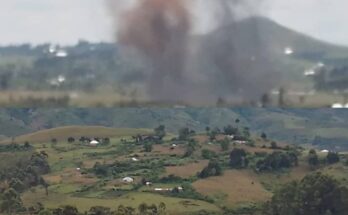
Meanwhile, reports from South Kivu indicate that fighting continues in areas including Kalingi, Bidegu, Kalongi, and Mikenke. Additional reports suggest that FARDC warplanes operating from Kalemie have recently been deployed over Minembwe as military operations intensify.
Observers warn that the growing confrontation between AFC/M23, international human rights organizations, and the Kinshasa government risks further deepening instability in eastern Congo, at a time when local communities continue to call for peace, justice, and long-term security.