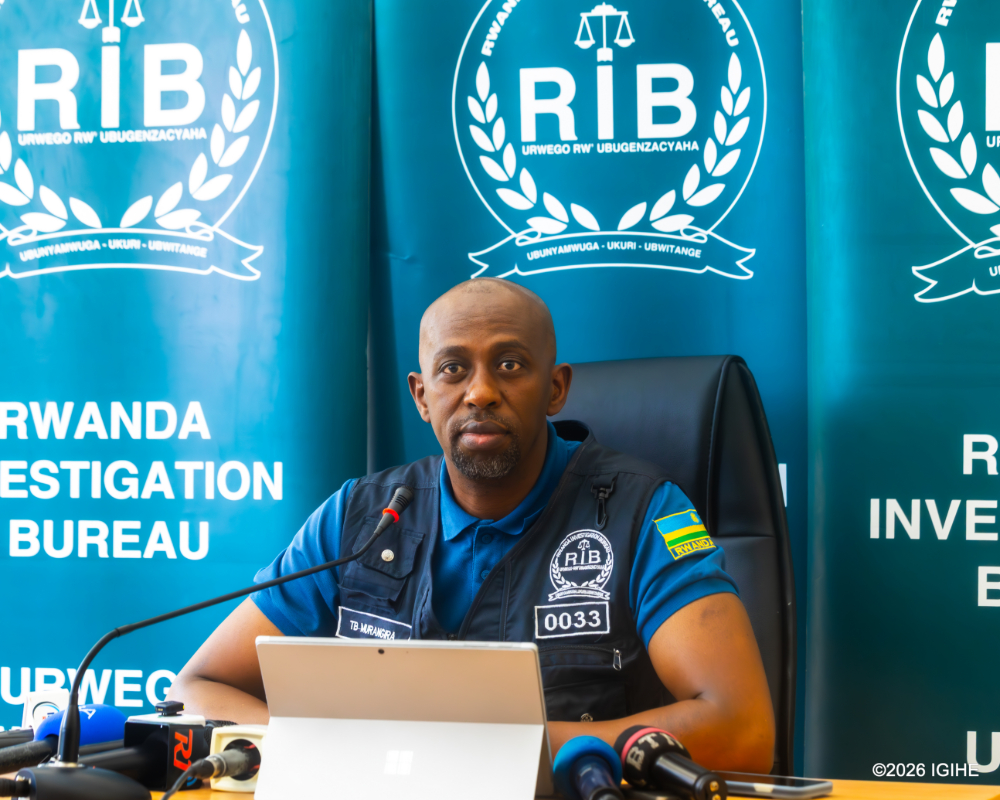

A renewed national conversation about domestic violence has emerged in Rwanda following comments from Rwanda Investigation Bureau (RIB) spokesperson Dr. Thierry Murangira, who urged men to seek justice through legal channels instead of retaliating when faced with abuse at home.
His remarks came as social media users continued to debate a viral video showing a woman identified as Shadia publicly slapping a man she described as her husband, accusing him of infidelity.
Speaking on June 19, 2026, at the RIB station in Nyamata during the handover of 140 recovered mobile phones worth more than RWF 40 million to their rightful owners, Dr. Murangira also addressed a series of homicide cases investigated by the bureau.
During the event, RIB presented three suspects linked to phone theft and eight other individuals under investigation for alleged murders committed across six sectors of Bugesera District.
According to Dr. Murangira, many violent crimes recorded since the beginning of 2026 have been linked to family disputes, property conflicts, jealousy between spouses, and alcohol abuse.
He explained that long-standing domestic disagreements often escalate over time, eventually leading to tragic outcomes when individuals allow anger to dictate their actions.
The spokesperson noted that some men arrested in connection with murder cases claimed they had been experiencing serious conflicts with their spouses, including situations they perceived as abuse or humiliation, before resorting to revenge.
However, he stressed that retaliation is never the answer.
“Any victim has the right to file a complaint at an Isange One Stop Center or at the nearest RIB station, whether that victim is a man or a woman,” he said.
Dr. Murangira further challenged the perception that a man who reports abuse is weak or dishonored.
“If your wife hits you and you choose not to retaliate, that is not cowardice. It is an act of manhood because you have managed to control your anger instead of letting it control you. Being a man is not about revenge; it is about knowing how to act wisely in difficult situations,” he said.
He added that Rwanda’s justice institutions do not discriminate based on gender when handling complaints.
“When someone comes to report a case, we do not look at whether that person is a man or a woman,” he emphasized.
His comments coincided with widespread reactions to footage recorded on Kigali’s KK159 Street during the night of May 30–31, 2026.
The video shows Shadia repeatedly slapping a man while accusing him of cheating on her. At one point she is heard telling bystanders, “Record this,” before warning them, “Don’t stand in my way.”
The footage quickly spread across social media platforms and ignited discussions about domestic violence against men, gender equality, and law enforcement responses.
Many online commentators praised the man’s restraint, arguing that responding physically could have worsened the situation and potentially led to criminal charges.
Others questioned whether society and institutions respond equally when male victims experience abuse.
The debate also revived memories of another incident in February 2026, when a woman was arrested after a video showed her assaulting her husband over money allegedly lost through sports betting. She later issued a public apology, acknowledging that her actions were inappropriate.
Legal experts and social observers argue that preventing domestic violence requires both men and women to reject revenge and instead rely on lawful mechanisms designed to resolve disputes and protect victims.
Under Article 107 of Rwanda’s Law No. 68/2018 governing crimes and penalties, intentional homicide remains one of the most serious offenses and carries a sentence of life imprisonment upon conviction.