
Flu season in the United States is heating up fast, and experts are warning that a new virus variant called subclade K could make this year’s outbreak more serious than usual.
The Centers for Disease Control and Prevention (CDC) reported that during the week ending December 6 — right after Thanksgiving — the proportion of doctor visits for fever with cough or sore throat rose to 3.2%. This is above the epidemic threshold, signaling that flu season is officially underway.
“By the calendar, flu season starts around early October, but the real marker is when activity rises above the threshold,” said Dr. Caitlin Rivers from Johns Hopkins Bloomberg School of Public Health. “The 3.1% threshold marks the onset of flu season.”
Flu activity is currently moderate to high in at least 14 public health regions. The Northeast is hardest hit, including New York City with very high activity, and states like New York, New Jersey, Connecticut, Massachusetts, and Rhode Island. Other states showing increasing flu activity include Louisiana, Colorado, Georgia, South Carolina, Texas, Puerto Rico, and Idaho.
This week, the U.S. also reported the first child death from the flu, raising concerns about a potentially severe season.
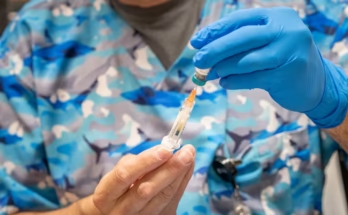
Dr. Tim Uyeki, chief medical officer of the CDC’s influenza division, stressed the importance of vaccination. “Influenza activity is increasing in the U.S. right now, and therefore that the time to get vaccinated for this season is right now,” he said.
New York state is showing early signs of a rough flu season. According to Dr. James McDonald, commissioner of the New York State Department of Health, cases started rising about two weeks earlier than usual. Flu hospitalizations have doubled in the past two weeks.
“It’s here, and it announced itself quite loudly,” McDonald said. He described the hospitalization curve as J-shaped, meaning severe cases are rising faster than normal. “More people are ending up in the hospital quicker compared to last year,” he added.
Hospitals in New York have been alerted to subtype specimens and follow strict infection control measures due to the rapid rise in cases.
Most of the flu viruses analyzed this season in U.S. labs are subclade K, a variant of influenza A H3N2. H3N2 seasons are often more severe, especially for older adults, leading to higher rates of doctor visits and hospitalizations.
Other countries, including Japan, China, the UK, Canada, and Australia, have also reported early and busy flu seasons. Australia, where subclade K was first detected, recorded nearly half a million confirmed flu cases, breaking the previous year’s record.
Scientists often look to Australia’s winter flu season as a predictor for the Northern Hemisphere. However, experts caution that flu is unpredictable. “If you’ve seen one flu season, you’ve seen one flu season,” said Dr. Jennifer Nuzzo of Brown University.
Even though last year was severe in the U.S., Nuzzo notes that back-to-back bad flu seasons are not typical. But with a new variant in circulation, previous patterns may not hold.
Dr. Angela Rasmussen, a virologist at the University of Saskatchewan, predicts this season could be serious. “Canada also has an early and brisk flu season,” she said. “Flu is spreading fast, and even school closures are happening.”
One challenge is that this new variant wasn’t included in this year’s flu shots, as it was identified after the vaccine strains were chosen. However, related strains in the vaccine still provide some protection.
Data from the UK shows that vaccines reduced the risk of emergency visits or hospitalization for H3N2 subclade K by almost 75% in children. Adults, including those over 65, saw lower protection — around 30% to 40%.
Dr. Rivers noted that vaccine protection in the U.S. may be slightly lower because of differences in vaccine production methods, with most U.S. vaccines being egg-based.
Even partial protection is valuable. Dr. Alex Greninger from the University of Washington emphasized, “Any protection is better than no protection. Vaccines reduce severity and help prevent hospitalizations.”
Flu vaccines take about seven days to reach full effectiveness. “If you get vaccinated today, your immune system will be ready by Christmas,” Greninger said.
Children are especially vulnerable because they have less natural immunity to influenza. Only 38% of U.S. children have received a flu shot this season, lower than the previous six years at this time.
Last year, at least 280 children died from the flu in the U.S., the highest number in a non-pandemic year since 2004. Most of the children were unvaccinated.
Flu shots cannot fully prevent infection or transmission, but they significantly reduce the chances of severe illness and hospitalization. Experts recommend combining vaccination with other preventive measures.
Dr. Rivers recommends wearing a mask in crowded indoor spaces during holidays and avoiding high-risk settings like indoor playgrounds. Opening windows or using air purifiers can also help reduce viral spread.
Flu symptoms, such as high fever, cough, sore throat, body aches, and chills, often appear suddenly. Testing and early use of antiviral medication within 48 hours can shorten illness and prevent complications.
The CDC and health experts urge everyone to take flu seriously this season, especially with the new subclade K variant circulating. Timely vaccination, good hygiene, and precautions can help families stay safe.