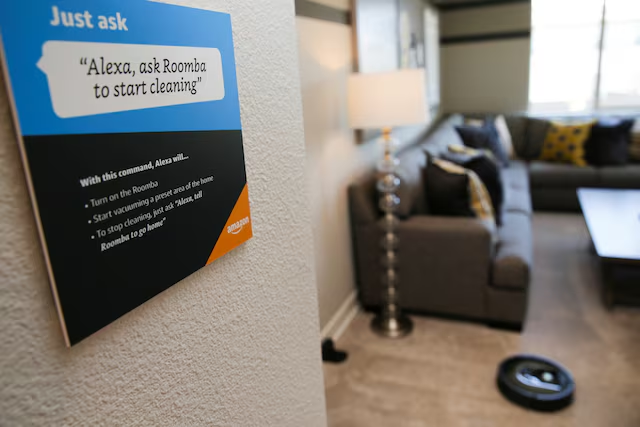
iRobot, the company behind the popular Roomba vacuum cleaner, has filed for bankruptcy protection. The news comes as the company struggles to stay competitive in an increasingly tough market.
On Sunday, iRobot announced it would go private after being bought by Picea Robotics, its main manufacturer. The deal aims to stabilize the company and keep its iconic products on store shelves.
The company raised concerns about its future back in March. Now, it has formally filed for Chapter 11 protection in Delaware bankruptcy court. The filing comes amid growing pressure from lower-priced competitors and new U.S. tariffs.
iRobot generated around $682 million in total revenue in 2024. However, profits have been shrinking. Chinese rivals like Ecovacs Robotics have pushed the company to lower prices while investing heavily in new technology upgrades.
The bankruptcy filing shows that iRobot still leads in important markets like the U.S. and Japan. Yet, the company is struggling to maintain margins as competition intensifies.
A significant challenge for iRobot has been U.S. tariffs. A 46% tax on imports from Vietnam, where the company makes its vacuums for the U.S., raised costs by $23 million in 2025. These tariffs also complicate future planning.
iRobot has a debt of about $190 million. This debt comes from a 2023 loan the company took to refinance operations while a European competition investigation delayed a planned Amazon buyout.
Amazon had previously tried to buy iRobot for $1.4 billion, but the deal was blocked. Afterward, iRobot fell behind on payments to Picea, its China-based manufacturer. Picea later acquired the company’s debt from investment funds managed by the Carlyle Group.
Under the bankruptcy plan, Picea will take 100% of iRobot’s equity. The company will also cancel the $190 million loan from 2023 and an additional $74 million owed to Picea under their manufacturing agreement.
iRobot confirmed that the bankruptcy is unlikely to disrupt its app services, customer programs, global partnerships, supply chain, or product support.
The company has faced dramatic changes in value over the years. During the pandemic, iRobot was valued at $3.56 billion due to high demand. Today, it is estimated to be worth only about $140 million, according to LSEG data.
iRobot was founded in 1990 by three roboticists from the Massachusetts Institute of Technology. The company initially worked on defense and space projects before launching the Roomba in 2002.
The Roomba quickly became a household favorite. Today, it holds about 42% of the U.S. market and 65% of the Japanese market for robotic vacuums.
Despite financial struggles, iRobot continues to produce its innovative cleaning robots. The company is headquartered in Bedford, Massachusetts, and employs 274 people.
The bankruptcy filing indicates that all other creditors and suppliers will be paid in full. This step is crucial for maintaining trust and ensuring the company can continue operations smoothly.
Analysts note that iRobot’s troubles reflect larger trends in the tech industry, where rising production costs, international competition, and tariffs can severely impact companies.
Experts say that Picea’s acquisition could help iRobot regain stability. By eliminating significant debt and streamlining operations, the company may focus on innovation and regaining market share.
Customers and fans of Roomba should not expect immediate changes. The app functionality and customer support are set to continue without interruption.
Industry watchers are curious to see how iRobot will navigate its post-bankruptcy phase. The company has a strong brand, and its robotics technology is still considered cutting-edge.
Some speculate that iRobot might also explore new markets and product lines. This could include smart home devices, AI-driven cleaning solutions, or partnerships with other tech companies.
While the bankruptcy is a setback, it may also be an opportunity. With Picea’s support, iRobot could restructure, innovate, and emerge as a stronger competitor.
The story of iRobot is also a reminder of how quickly tech companies can rise and fall. From a $3.56 billion valuation to $140 million, the company has faced dramatic highs and lows in just a few years.
For now, Roomba fans can continue to enjoy their robotic vacuum cleaners, even as the company behind them undergoes major changes behind the scenes.