Millions of people around the world woke up to a shocking truth after watching what they thought was a normal goodbye video on YouTube.
Dr Robert Murray-Smith, a well-loved inventor and YouTuber with nearly 600,000 subscribers, had filmed one final clip and scheduled it to go live the day after he took his own life.
He was 62 years old.
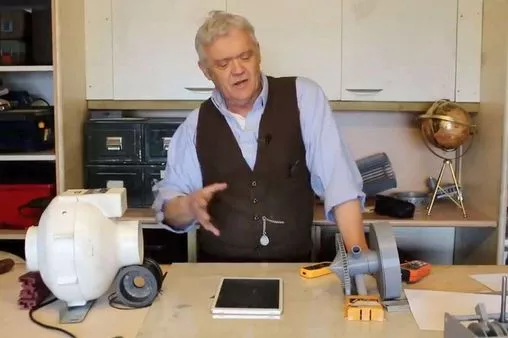
On his popular channel, Thinking and Tinkering, Dr Murray-Smith had spent more than a decade sharing clever inventions and practical ideas. To many viewers, he was not just a creator, but a teacher, an inspiration, and a familiar face.
In the final video, titled “My Last Video”, posted on September 26, he calmly told his followers it would be his last.
He explained that the videos were becoming “a little repetitious and, well, boring to be honest,” and said it felt like the right time to stop while things were going well.
“Although I think the channel is doing rather well, it’s one of those things to finish on a high,” he said.
Dr Murray-Smith thanked his audience deeply, especially for their support during difficult moments in his life.
“At those difficult times in my life, when people here have actually been tremendously and genuinely supportive, I want to thank everybody,” he said.
He reassured viewers that the videos would remain online forever as reference material.
“I do wish you all the very best,” he added. “Please do remember me every now and then and let’s call it adieu while we’re all really happy.”
The tone was warm, calm, and gentle. For many viewers, nothing seemed wrong.
But the next update shattered that sense of peace.
On October 7, Dr Murray-Smith’s brother, Dave Smith, posted a video titled “RIP Robert Murray-Smith (1963–2025)”.
“I’m very sad to report that Robert died the day before that video,” he said.
Dave explained that his brother had taken his own life after struggling deeply in recent years.
Dr Murray-Smith, who lived in Herne Bay, had been devastated by the death of his wife, Patti, who passed away around a year and a half earlier.
“He did not take the death of his wife very well,” Dave said. “He found her absence a real struggle.”
On top of grief, Robert’s physical health had also declined. He was in constant pain and struggled to walk.
“That contributed massively to what was already a depression,” his brother explained.
Dave also spoke openly about how difficult it had been to talk to Robert about his mental health.
“If ever you asked Robert how he’s feeling, he would say, ‘I’m fine. Everything’s fine,’” he said.
When family members tried to push further, Robert would become passive-aggressive and shut down.
“You saw his videos — you wouldn’t realise there was misery underneath all that,” Dave said. “His mask was very, very well tuned.”
The YouTube community meant everything to Robert.
“The community on his YouTube channel was profoundly important to him,” Dave said. “He was with you all for about 11 years.”
That is why his family felt it was important to tell viewers the truth.
Before the news broke, fans had already flooded the comments with gratitude and love.
One wrote: “God bless you, Robert. Not for your channel, but for who you are. Your spirit shines bright.”
Another said: “The end of an era. You’ve touched the lives of millions, and that’s an awesome feat.”
Dr Murray-Smith’s impact was huge. His channel contains more than 2,500 videos, watched almost 80 million times.
He shared how to build off-grid batteries, furnaces, centrifuges, and even experiments with diamagnetic graphite — a rare form of carbon that repels magnetic fields.
He once said his goal was to empower people to make things themselves.
That mission clearly worked.
Thousands of people left messages after his death. One person shared that Dr Murray-Smith had saved their life by teaching them how to build heaters while they were homeless.
“Robert was a genuine genius and cared for the world,” one commenter wrote.
Another added: “In a world full of horrible people, be a Robert Murray-Smith.”
To honour his memory, his family has begun fundraising for the charity Campaign Against Living Miserably (CALM).
Dave explained why they chose this cause.
“Men typically find it next to impossible to talk about their feelings,” he said. “Robert certainly fell into that category.”
He added that he believes his brother had been living miserably since his wife’s death.
Dave also announced he would create a future compilation video of Robert’s best moments.
“I’d like to thank you all for the support that you gave Rob over his 11 years,” he said emotionally. “He appreciated it enormously.”
Dr Robert Murray-Smith’s story is a painful reminder that even people who seem joyful, brilliant, and fulfilled can be silently struggling.
If you are feeling overwhelmed or hopeless, you are not alone — and help is available.
If you’re in the UK, you can contact Samaritans on 116 123 or CALM on 0800 58 58 58.
If you’re elsewhere, local crisis lines can be found via your health services.