
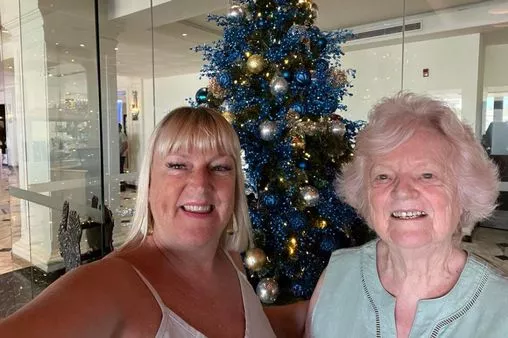
For Jan Edis, Christmas has always meant family, long flights, and careful planning. At 84, she is a seasoned traveller who usually spends the festive season with her daughter in Australia before heading to Sri Lanka, where she stays for a month every year.
Because flights to Australia are expensive, Jan starts looking for the best fares a full year in advance. It is something she has done many times before, without any problems.
But last year, her careful planning nearly cost her thousands of pounds.
Jan, who lives in a retirement village, fell victim to a bogus travel agent scam — and now she is speaking out to warn others ahead of Christmas.
In January 2024, Jan was online comparing flight prices, just as she always does. While browsing, she suddenly received a phone call from a travel company.
At the time, she did not know how they found her number. Now, she believes the scammers may have tracked her IP address, a unique number linked to online activity, and used it to get her personal details.
The caller offered Jan return business-class tickets to Australia for around £5,000. Other fares she had seen ranged between £5,000 and £8,000, so the price did not seem suspicious.
“They even said I could pay in instalments,” Jan explains. That offer made it feel more manageable, and she decided to go ahead.
Looking back, Jan admits she found it unusual that a travel company called her directly. Still, she tried to be careful.
“I asked for their ATOL certificate,” she says. “They sent it, so I thought everything was legitimate.”
The deal did not sound too good to be true, which made it even more convincing. “What they were offering wasn’t ridiculously cheap,” she says. “So I didn’t think it was a scam.”
Jan agreed to pay the full amount in instalments. She paid £1,000 first, then four payments of £500, and a final payment of £670 in June last year. All payments were made by bank transfer.
“When I made the last payment, they promised the tickets would arrive by email that evening,” Jan says. “But they never came.”
The next day, she tried calling the company again. This time, she could not get through to anyone.
Soon, the phone numbers stopped working. Emails went unanswered. That was the moment Jan knew something was very wrong.
The fake company looked completely professional. Their website used the same banner and logos as a well-known travel firm Jan had used before.
But when she looked closely, she noticed a small detail — there was an extra “s” in the company name.
“I was so angry with myself,” Jan says. “It all looked completely kosher.”
Thankfully, Jan acted quickly. She had paid through two different banks and was able to recover her money. However, it was not easy.
“I had to prove I’d done my due diligence,” she explains. This included showing that she had asked for the ATOL certificate before making the payments.
Jan says she is no stranger to scams. In fact, she usually spots them easily.
“I get calls all the time,” she says. “People saying there’s a problem with my computer, messages pretending to be my grandchild asking for money, all sorts.”
She even recalls one scammer who claimed to work on an oil rig and said he was in love with her. “I knew it was a scam,” she laughs. “I told him I had no money.”
When the man later asked her to take out a £100,000 loan, she knew exactly what was happening.
“I’m used to scams and attempted scams,” Jan says. “It’s unfair, really. We work hard all our lives only to get targeted like this.”
After getting her money back, Jan had to rebook her flights. Because it was closer to the departure date, the new tickets cost her £500 more.
She has now switched to using the established travel firm Trailfinders and prefers to visit her local shop to book flights in person.
Determined to stop others from going through the same ordeal, Jan is now raising awareness about scams. She has teamed up with Ask Silver, a free scam-checking tool.
Ask Silver allows users to take a photo or screenshot of an email, website, or leaflet and send it via WhatsApp. The tool uses AI to spot red flags and suggest safe next steps.
Alex Somervell, co-founder of Ask Silver, says Jan’s story is sadly very common.
“We see so many cases where a single convincing scam is enough to make people withdraw from technology altogether,” he says.
“But it doesn’t have to be that way,” he adds. “With tools like Ask Silver, people can feel reassured that someone is double-checking the fine print.”
He says the goal is to help people stay connected, book trips, and use technology without living in constant fear of being scammed.
As Christmas approaches, Jan hopes her experience will help others slow down, double-check, and trust their instincts.
“One small detail can make all the difference,” she says. “And if something feels even slightly off, stop and check.”