
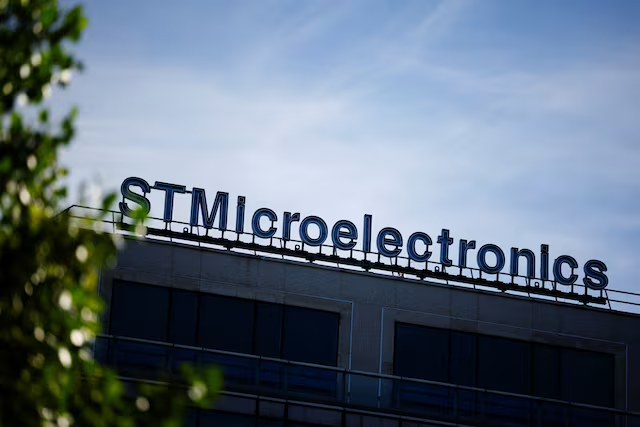
The story of space technology is changing fast, and it is no longer just about rockets. Over the past decade, European chipmaker STMicroelectronics has quietly become a critical player in Elon Musk’s Starlink satellite network.
According to Remi El-Ouazzane, president of STMicro’s microcontrollers and digital integrated circuits division, STMicro has shipped more than 5 billion radio-frequency antenna chips to SpaceX since their partnership began.
“The past 10 years of user terminals in terms of volume could actually double over the next two years,” El-Ouazzane told Reuters, hinting at the enormous growth potential of the Starlink network.
These tiny chips are the building blocks of Starlink’s internet service. Each user terminal, what some call a “satellite dish”, relies on them to send and receive signals to orbiting satellites. Without them, the fast, low-latency internet promised by Starlink would not be possible.
STMicro’s chips are built using BiCMOS technology, a method that allows them to handle high-speed data while enduring the harsh conditions of space.
“I expect many lower-orbit satellite players to leverage the technology,” El-Ouazzane said, suggesting that the chipmaker’s influence may expand beyond Starlink.
The collaboration between STMicro and SpaceX began around 2015 when Elon Musk met with the chipmaker’s CEO, Jean-Marc Chery. At that time, the scale of the partnership was largely unknown to the public.
Now, STMicro is revealing just how big the contract has grown. Supplying billions of antenna elements has become a key driver for the company’s specialized chip business.
Starlink currently operates in more than 150 markets worldwide and serves approximately 8 million users, according to its website.
The growth of Starlink reflects a broader shift in the space industry. Projects once led exclusively by governments are now increasingly driven by commercial companies.
SpaceX, Eutelsat, OneWeb, and Amazon’s planned Leo network are all competing in this commercial space boom. Each of these projects demands advanced chips capable of handling massive data rates.
High-quality, specialized chips are essential for these satellites. They must function in extreme conditions, from intense radiation in space to rapid temperature changes.
STMicro’s chips, often called radio-frequency front-end modules, are perfectly suited for these challenges. They ensure that signals travel efficiently between Earth and space.
The company is not stopping with current Starlink terminals. STMicro is also preparing to supply components for SpaceX’s upcoming inter-satellite laser links.
These laser links will allow satellites to communicate directly with each other in space, dramatically improving speed and reliability for users on the ground.
Beyond Starlink, STMicro is collaborating with European companies like Thales and Eutelsat. These partnerships include projects such as the European Union’s planned Iris 2 satellite constellation.
This signals a larger trend: specialized European chipmakers are positioning themselves as global leaders in the commercial space sector.
STMicro’s decade-long partnership with SpaceX also illustrates the growing interdependence between hardware manufacturers and commercial satellite operators.
As Starlink expands, demand for high-quality antenna chips will rise, potentially doubling deliveries by 2027. This means billions more chips will leave European factories for satellites orbiting the Earth.
The success of STMicro and Starlink demonstrates how tiny components can have massive impacts. Each chip is small, but together they form the backbone of a network serving millions of people worldwide.
Industry analysts say that as more players enter the low-orbit satellite market, the need for these chips will grow even further. STMicro’s technology may become the standard for years to come.
The story of these 5 billion chips is also a story of global innovation, connecting Europe and the United States in the rapidly evolving world of space commerce.
For SpaceX, these chips help keep Starlink ahead of competitors, offering reliable internet in regions that have historically been underserved.
Looking forward, STMicro’s work with laser links and new constellations could reshape satellite communications entirely, ushering in a new era of faster, more connected Earth.
This decade-long partnership proves that space technology is not just about rockets, it’s also about tiny chips and big ambitions.